June 30, 2026
Eliminate Careless Errors in VCE Maths Methods With Better Exam Practice

Achieving a raw 50 in VCE Maths Methods requires more than conceptual knowledge; it demands the systemic elimination of careless errors through active verification.
Many students lose marks because their exam execution becomes inconsistent under pressure, not because they lack the skills. By treating exam execution as an exercise in reducing uncertainty, students can secure top-tier marks regardless of exam-day pressure.
At Premier Education, we provide methods tutoring in Box Hill and online that helps students create systems to make accurate performance repeatable, even on a stressful exam day. Your first lesson is free.
Key Takeaways (TL;DR)
Eliminating careless errors in VCE Maths Methods requires treating exam practice as a means of reducing unknowns. The secret to a raw 50 is replacing passive re-reading with aggressive, mathematical verification to lock in your marks.
- Treat exam preparation as a way to eliminate uncertainty and buffer against stress.
- Careless arithmetic errors are systemic habits requiring an active verification protocol, not passive re-reading.
- Budget 10 to 15 minutes per exam to mathematically prove answers using reverse substitution.
- Use the 15-minute reading time to separate mental planning from mechanical execution, lowering cognitive load.
How High-Volume Practice Creates a Performance Buffer
Achieving a raw 50 in VCE Maths Methods requires treating exam practice as an exercise in variable control, not just a measure of mathematical knowledge. By building a massive performance buffer through high-volume practice, you insulate your final score against exam-day variables like stress, fatigue, or illness.
When you build a large buffer, even a lacklustre performance on the day will outperform the state. Instead of hoping for a ‘good day’, you guarantee a high baseline score regardless of external pressures.
High-performing students use timed practice exams to simulate adversity, forcing their brains to process complex calculus and algebra under less-than-ideal conditions. This psychological conditioning ensures that when the final VCAA exams arrive, the mechanics of problem-solving remain intact, allowing them to secure top-tier marks with clinical precision and zero reliance on luck.
My VCE Maths Methods Exam Story
If I didn’t have a checking protocol, my raw 50 was at the mercy of nerves. During my Exam 1, I caught two errors in the final 10 minutes: not because I was lucky, but because I had budgeted time for systematic checking.
High-volume exam practice tightens your range of potential outcomes, ensuring that even a bad performance day still yields a top-tier result.
By completing a high volume of practice papers under strict conditions, you tighten that distribution. You are building a protective moat around your target study score. When your ‘worst-case scenario’ execution is still mathematically rigorous enough to score above 90 per cent, you have successfully engineered certainty.

Why You Keep Making Careless Errors in VCE Maths Methods
Eliminating careless arithmetic mistakes requires explicit changes to problem-solving habits, not additional theory revision. The human brain naturally falls into cognitive bias during high-stakes exams, meaning passive re-reading of your own work will actively reinforce errors.
If you write that 3 x 4 = 9, passively scanning that line 10 minutes later will likely make you incorrectly perceive a 12, because your brain anticipates the correct answer.
How Do I Keep From Making Careless Mistakes?
To break this cycle, you must stop treating arithmetic errors as random anomalies and start treating them as systemic flaws in your mechanical execution.
True error elimination demands a classification system where you log specific mechanical slips like dropping negative signs, misplacing brackets around polynomial terms, or forgetting the ‘dx’ in an integral. By explicitly logging these habitual traps, you push your brain into a state of heightened awareness, replacing passive assumption with mathematical precision.
Mechanical Error Hit-List
Rather than simply noting that a response was incorrect, you must record the exact error mechanism. Adding these specific slips to your mechanical error log transforms abstract mistakes into actionable data. These specific mechanical slips are consistently flagged in official VCAA external assessment reports:
| Mechanical Error | Correction Protocol |
| Dropping negative signs during polynomial expansions. | Expand negative terms in a separate bracketed step before simplifying. |
| Misplacing or forgetting brackets when subtracting algebraic terms. | Always enclose subtracted algebraic groupings in explicit parentheses. |
| Omitting the inverse function graph symmetry. | Graphs of inverse functions must explicitly demonstrate symmetry about the line y = x. |
| Incorrect terminal substitution in definite integrals. | Write F(b) – F(a) inside large square brackets to force evaluation order. |
Execution failures fall into two categories:
- Conceptual gaps arise when you do not know the mathematical theory required to even approach the question.
- Careless gaps occur when you know the exact steps but fail to execute them mechanically, providing a dangerous false sense of security.
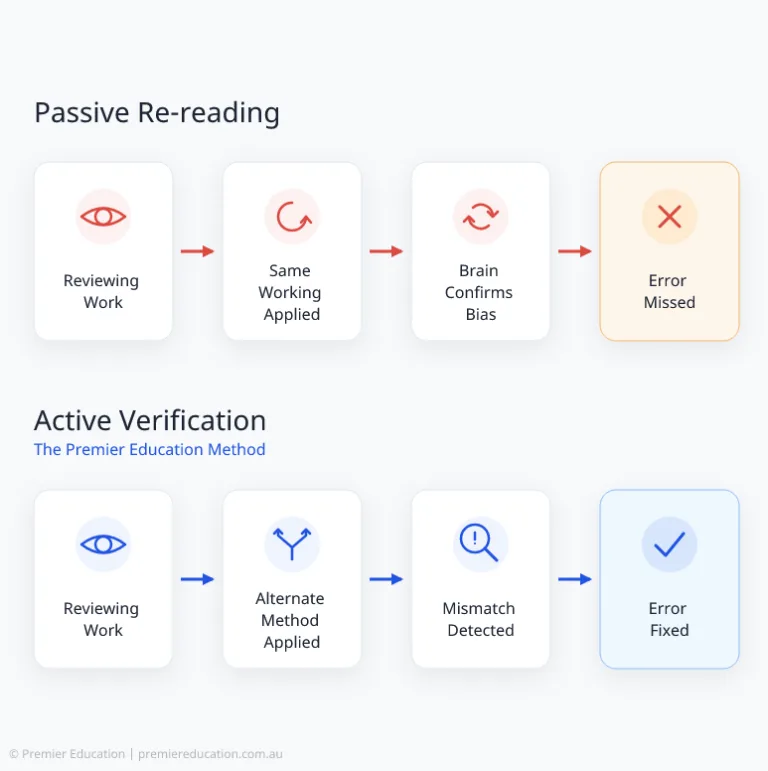
Passive re-reading during an exam allows cognitive bias to hide arithmetic errors; active verification forces your brain to re-evaluate the mathematics from scratch.
The Active Verification Protocol: Exam Checking Strategies
Active verification is the exam technique of mathematically proving your answer through reverse substitution or alternative pathways, rather than passively re-reading your steps. To achieve a raw 50, you should budget 10 to 15 minutes exclusively for this aggressive checking.
Deploying the three tiers of active verification ensures you efficiently allocate your checking time, reserving the time-consuming ‘blind redo’ only for high-risk questions.
Executing the 3 Tiers of Active Verification
1. Reverse Substitution: Mathematically prove your answer by working backwards. If you find an antiderivative, differentiate it to ensure you return to the original function. If you find x-intercepts, substitute them back into the initial equation to confirm they yield exactly zero.
2. Alternate Method: Solve the exact same problem using a completely different mathematical pathway (e.g., calculating an area using a different integration bound). If both methods converge on the identical solution, the answer is verified.
3. The Blind Redo: Physically cover your original work with a blank piece of paper and re-solve the question entirely from scratch. This prevents your brain from falling into the same flawed logical grooves if you made a subtle arithmetic mistake on your first attempt.
To execute active verification under time pressure, implement these strategies:
- Flag Questions: Draw a circle next to high-risk, multi-part questions to flag them for verification. Place a tick through the circle only once it is mathematically proven.
- Allocate Time: Budget some spare time in Exam 1 and Exam 2 exclusively for checking, not for attempting unknown questions.
- The Final Two Minutes Rule: Never erase or drastically alter a complex answer in the final two minutes. Panic can lead to errors; use this time only to verify units, decimal places, and notation. If you realise an answer is wrong but don’t have time to redo it, leave it. VCAA assessors can often award consequential or method marks for flawed working, but they cannot award marks for erased blank space.
VCAA Assessment Rules: Formatting Answers to Prevent Lost Marks
VCAA assessors ruthlessly deduct marks for poor mathematical grammar, making it essential to strictly adhere to official notation, exact values, and precise graph characteristics. You must format your responses exactly as defined by the study design to prevent sacrificing marks.
According to the 2023 and 2024 VCE Mathematical Methods 1 external assessment reports, students consistently lose marks for:
- Failing to specify the base of a logarithm as a subscript
- Omitting the ‘dx’ in integration statements
- Incorrectly naming derivative functions. For example, if a question defines a function as f(x), writing dy/dx= as your derivative is invalid and will not be awarded marks.
Furthermore, graphical responses require precision; asymptotes must be drawn distinctly as dashed lines with equations provided, and curves must demonstrate correct asymptotic behaviour without curling away. Internalising these rigorous formatting constraints, including the mandatory use of exact values, protects your marks from administrative penalties.
Graphs of inverse functions must strictly demonstrate symmetry about the line y = x without curling away from asymptotes. Furthermore, all numerical answers must be given as exact values (such as fractions or surds) unless the question explicitly asks for decimal places.
| Common Student Error | Correct VCAA Notation | Consequence of Error |
| Writing an integral without respect to a variable | ∫ f(x) dx | Statement is mathematically invalid; marks deducted. |
| Using incorrect derivative nomenclature | f′(x) (when given f(x)) | Assessors will not accept y = or dy/dx if the function is f(x). |
| Writing logarithms without bases | logₑ(x) | Ambiguity in the base leads to lost marks. |
| Sketching asymptotes poorly | Dashed line with equation (e.g., x = 2) | Faint lines, solid lines, or a lack of equation lose graphing marks. |
| Ignoring probability domain restrictions | Distinct parameters (e.g., x ∈ [0, 5] vs x ∈ {0, 1, 2…}) | Applying continuous probability methods to discrete variables, or vice versa, results in zero marks for the method. |
Table Reference: Sourced directly from the grading rubrics of the 2023 and 2024 VCAA Mathematical Methods Assessment Reports.
VCAA assessors require exact mathematical grammar; failing to include proper notation like ‘dx’ or correct function names will result in immediate mark deductions.
Tips for Maximising Reading Time for Exam 1 and Exam 2
Maximising VCE Maths Methods reading time requires separating your mental planning from physical execution, reducing cognitive load during the actual writing period. Because reading time constitutes 25 per cent of Exam 1, you must utilise it strategically to manage cognitive load.
Exam 1 Tips
During Exam 1, you should mentally map out the straightforward calculus and algebra questions immediately, then dedicate the majority of the 15 minutes to mentally dissecting the most complex, multi-step problems.
By plotting your algebraic pathway beforehand, you avoid simultaneously planning and executing under pressure, which is a primary cause of careless errors.
Exam 2 Tips
For Exam 2, abandon any attempt to solve the multiple-choice questions during reading time, as these are designed to be efficiently dismantled using your Computer Algebra System (CAS) later.
Instead, invest your entire 15 minutes into comprehending the extended response section, identifying the high-value questions, and noting critical domain restrictions or required units.
The reading time strategy differs fundamentally between the two exams. Exam 2’s reading time should be reserved for decoding complex extended response questions, as multiple-choice questions require technology.
Scan extended response questions in Exam 2 for specific wording constraints. Look out for the difference between finding the equation of a tangent and a normal. Instruct yourself to explicitly identify if a question is asking for the ‘average value of a function’ versus the ‘average rate of change’, as the 2023 VCAA Exam 2 Report noted this mix-up as a highly prevalent student comprehension error.
By explicitly noting these details during reading time, you prime your brain to execute flawlessly once the clock starts.
Our Maths Methods Tutoring Team Answers Your Frequently Asked Questions
1. Are Maths Methods good for my ATAR?
VCAA’s scaling system rewards students who take harder subjects, so a strong Maths Methods score carries more weight toward your ATAR than an equivalent score in an easier subject.
2. How do I avoid careless mistakes in VCE Maths Methods?
To eliminate careless mistakes, implement an active verification protocol. Instead of passively re-reading your work, which reinforces cognitive bias, mathematically prove your answer. Use reverse substitution (like differentiating an antiderivative) or solve the problem using a completely different method to ensure both pathways yield the exact same result.
3. What is the difference between Maths Methods Exam 1 and Exam 2?
Exam 1 is a 60-minute, technology-free assessment that tests your raw algebraic manipulation, calculus skills, and knowledge of exact values.
Exam 2 is a 120-minute, technology-active paper consisting of multiple-choice and extended response questions, heavily relying on your proficiency with a Computer Algebra System (CAS).
4. How should I use reading time in the VCE Methods Exam 2?
Do not waste reading time on multiple-choice questions, as they are designed to be solved quickly with your CAS calculator later. Instead, dedicate the 15 minutes to reading and decoding the multi-step extended response questions, actively identifying domain restrictions, required units, and complex wording.
5. Do I lose marks for forgetting ‘dx’ in Methods exams?
Yes. VCAA examiners strictly penalise poor mathematical grammar. You will lose marks if your integration statements are missing the ‘dx’, if you omit the base in logarithmic functions, or if you name a derivative incorrectly (such as writing dy/dx= instead of f'(x)).
6. What should I focus on during VCE Maths Methods exam revision?
For effective VCE Maths Methods exam revision, you should prioritise timed practice exams, error tracking, and active verification rather than passive note-reading. It’s also key to focus on reducing careless mistakes and improving consistency under pressure.
7. How can a VCE Maths Methods tutor help improve my performance?
A VCE Maths Methods tutor is incredibly valuable for exam preparation. Your VCE tutor will combine strong conceptual teaching with exam-specific preparation, including timed assessments and active problem-solving, giving you tools for managing exam pressure and reducing careless errors.
Engineering Your VCE Maths Methods Success
By building a high-volume performance buffer, logging mechanical errors, enforcing a strict active verification protocol, and treating VCAA formatting rules as non-negotiable laws, you completely remove luck from the equation.
If you want to engineer your own raw 50 performance buffer and eliminate careless errors entirely, book a free trial lesson with our VCE Maths Methods tutors today. Let us help you turn potential into precision.
Book a free trial lesson Enrol now
Author
Premier Education
Our team of tutors have achieved perfect 99.95 ATARs, perfect 50 study scores, and have accumulated over 20 years of combined tutoring experience. We have made it our personal mission to not only help you succeed in Mathematics and English, but become well rounded students equipped to face any challenge in life.