June 4, 2026
VCE Maths Methods Exam Strategy: Key Tips and Careless Errors

To stop losing marks to preventable errors in VCE Maths Methods, you must systematically track your arithmetic slips using an error log and actively use exam reading time to mentally map out your solutions.
In this guide, we’ll explain how to separate careless mistakes from conceptual gaps, use error logs efficiently, and build stronger exam habits before your next SAC or final exam.
If you need support refining your exam technique, our VCE Maths Methods tutors in Melbourne at Premier Education offer small group classes, detailed feedback, practice SACs, and more. Your first lesson is free.
How to Stop Making Silly Mistakes in Maths (Understanding vs. Careless Errors)
To stop making silly mistakes in maths, you must first categorise your lost marks into two distinct groups.
- Conceptual Errors: Gaps in mathematical theory that are fixed linearly through targeted study.
- Careless (Arithmetic) Errors: Execution slips (like dropping a negative sign) that occur despite knowing the correct problem-solving method.
While conceptual gaps require targeted study, careless slips require strict habit changes.
- Conceptual errors are linear problems that can be solved by asking a teacher or reading a worked example.
- Careless or arithmetic errors, however, are process failures stemming from poor habits, such as doing multiple algebraic steps in your head or dropping a negative sign mid-calculation.
At Premier Education, we track this phenomenon using our error framework. While conceptual errors taper off quickly to zero as you study, careless errors are deeply ingrained bad habits that decline much more slowly and will consistently cost you marks unless actively managed.
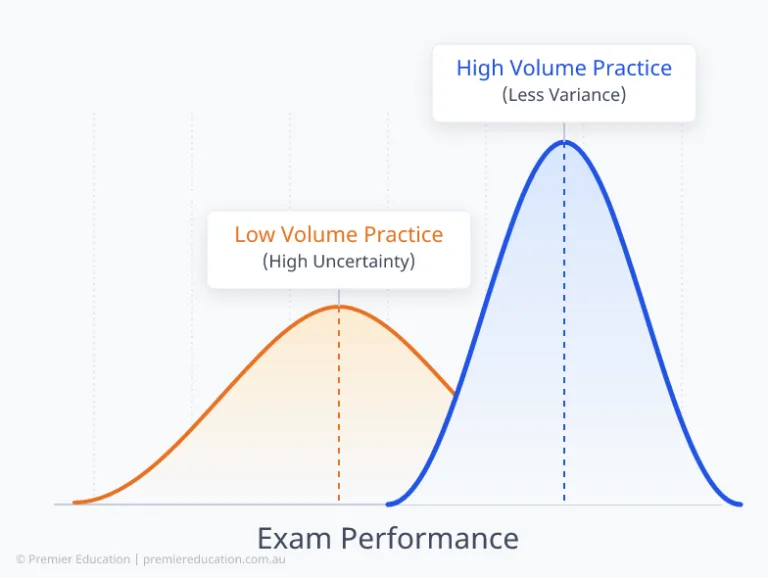
The Mathematical Proof: Why Careless Mistakes Cost More Than ‘Separator’ Questions
Careless mistakes damage your VCE Maths Methods study score far more than failing the hardest exam questions. VCAA standard exam structure allocates roughly 90 per cent of marks to foundational syllabus applications, reserving only 5 to 10 per cent for highly complex ‘separator’ questions designed to distinguish the top tier.
If you focus on eliminating careless mistakes on the accessible 90 per cent of the exam, you will mathematically outperform a gifted student who solves the hardest questions but lacks accuracy.
| Student Profile | Separator Question Performance | Execution on Standard Questions | Final Score |
| Adam (Disciplined) | Misses final 2-mark separator (-2) | Zero careless errors (-0) | 38/40 |
| Barry (Gifted but Careless) | Solves 2-mark separator (-0) | Drops 3 marks to silly arithmetic (-3) | 37/40 |
When you lose a mark on a straightforward product rule question because you dropped a negative sign, that mark holds the exact same weighting as a mark earned through ten minutes of gruelling algebraic manipulation on the final separator question.
By refining your execution and ensuring perfect accuracy on the questions you already know how to do, you build a mathematical safety net that protects your score from the natural fluctuations in exam difficulty.
The Most Common Careless Mistakes in VCE Maths Methods (According to VCAA)
Based on the 2025 VCE Mathematical Methods 1 external assessment report, the most common careless mistakes involved incorrect notation, missing brackets, and ignored domain restrictions. VCAA examiners strictly penalise poor communication and incorrect mathematical grammar, even if the final numerical answer is correct.
- Calculus notation errors occur frequently when integrating. Students often forget to include the ‘dx’ statement or write dy/dx when y has not been defined. If a function is given as g(x), you must formally name the derivative g'(x).
- Bracket discipline is strictly enforced. VCAA examiners explicitly noted that when enacting the product rule, expressions like x^2 and -sin(x) frequently appeared as a difference of two terms (i.e., x^2 – sin(x)) rather than a product (x^2(-sin(x))) because students failed to use brackets.
- Domain awareness is critical. You must check if your final answers fall within the restricted domain provided in the question stem. Providing a general solution when a particular domain is specified is a classic, preventable error. Confusing inclusive [ ] and exclusive ( ) brackets will also result in a lost mark.
- The oversimplification trap catches many top students. Once you have arrived at a mathematically correct answer that satisfies the question, stop writing. Although not required, students frequently decide to factorise their answer, introducing unnecessary potential for misinterpretation.
How to Create a VCE Maths Methods Error Log
The most effective way to stop making careless mistakes in maths is to maintain a dedicated error log throughout your VCE Maths Methods preparation. Every time you complete a practice exam or SAC, you must track every dropped mark and categorise it as either a conceptual error or an arithmetic error.
A high-quality error log requires immediate self-reflection. The best time to review an exam and log your mistakes is on the exact same day you sit it, while your thought processes and problem-solving decisions are still fresh in your mind.
| Date | Exam | Score | Error Categorisation | Specific Mistake Logged |
| 16/08 | VCAA 2024 Exam 1 | 33/40 | Conceptual | Failed to recognise area between graphs logic. |
| 16/08 | VCAA 2024 Exam 1 | 33/40 | Careless | Forgot the negative sign in the quotient rule. |
| 16/08 | VCAA 2024 Exam 1 | 33/40 | Careless | Ignored the restricted domain x > 0 |
| 16/08 | VCAA 2024 Exam 1 | 33/40 | Careless | Found the equation of the tangent instead of the normal. |
Review this log weekly. Before your next SAC or practice exam, extract your top three most frequent careless mistakes and write them down as a strict checklist. By forcing your brain to consciously look for your specific historical errors, you disrupt the bad habits that cause them.
When you review this log before your next practice run, your tailored pre-exam checklist becomes highlighting domains immediately, watching negative signs in fractions, and reading the final sentence of every question twice.
This is also where structured maths tutoring can help. A Maths Methods tutor can identify whether your lost marks are coming from weak conceptual understanding, poor exam technique, or repeated careless slips that need a more deliberate correction strategy.
Exam Execution: Using Reading Time to Minimise Errors
In VCE Maths Methods Exam 1, the 15 minutes of reading time accounts for 25 per cent of the total duration. To stop making silly mistakes, use this time to mentally map out the exact steps required to solve the questions you already know how to do. This can free up your cognitive load for calculation during writing time.
Careless errors multiply when your brain attempts to multitask. If you are simultaneously trying to figure out how to solve a problem while actively performing the arithmetic, your cognitive load maxes out, and negative signs get dropped. Active planning during reading time allows you to separate the strategy from the execution.
The ‘Rule of Three’ reading strategy prevents misreading errors by forcing cognitive separation between planning and execution.
| Phase | Action | Goal |
| During Reading Time | Mentally plan your mathematical roadmap for the questions you understand. | Free up your cognitive load for pure calculation during writing time. |
| Before Writing | Scan and highlight high-impact details like domain restrictions, specific | Anchor constraints in your working memory before starting the arithmetic |
| units, and rounding instructions. | ||
| After Calculating | Re-read the final sentence of the question. | Ensure you actually answered what was asked and satisfy the initial constraints. |
Common Questions About Managing VCE Maths Errors
1. Is Maths Methods good for ATAR?
Many students avoid Maths Methods because it’s demanding, but that’s exactly why it scales well. VCAA’s scaling rewards students who tackle harder subjects, so a solid Methods score can lift your ATAR significantly more than the same score in an easier subject
2. How do I stop making careless mistakes in maths exams?
Maintain an active error log to track your specific recurring mistakes, mentally plan your problem-solving steps during reading time, and explicitly highlight high-impact details such as domains and units before writing. Treating accuracy as a skill to be practised, rather than an inherent trait, is the key to preventing mark loss.
3. Can a VCE Maths Methods tutor help with careless mistakes?
Absolutely. VCE Maths Methods tutoring can help students identify recurring careless errors, review their work, and build stronger exam habits through targeted feedback.
At Premier Education, we provide students with regular feedback through progress tests, practice SACs, term assessments, and more.
4. What is the difference between a conceptual error and an arithmetic error in maths?
A conceptual error means you do not understand the underlying mathematical theory required to solve the problem, which can be fixed by studying the topic. An arithmetic or careless error means you knew the correct method but made a slip in execution, such as dropping a negative sign or copying the wrong number.
5. How many marks are ‘separator’ questions worth in VCE Maths Methods?
Based on Premier Education’s internal analysis of past exams, VCAA typically reserves roughly 5 to 10 per cent of exam marks for highly complex separator questions. These problems are designed to differentiate among the top-tier students. Focusing on perfect accuracy across the rest of the paper can yield a much higher overall score.
6. Should I simplify my final answer in VCE Maths Methods?
You should only simplify your final answer as far as required by the specific question. VCAA examiners frequently note that students lose marks by performing an unnecessary extra simplification step (such as factorising out a common variable) and making an algebraic error in the process. If the question does not demand specific forms, leave the correct unsimplified answer.
Secure Your VCE Maths Methods Study Score With Maths Methods Tutoring
Prioritising the hardest questions while dropping foundational marks is a mathematically flawed strategy. By separating your conceptual gaps from your execution failures, implementing a strict error log, and using active reading time to separate planning from calculating, you can naturally elevate your final study score.
We’ve developed our own exam tracker for students to categorise and eliminate mistakes. If arithmetic errors are suppressing your study score despite strong conceptual knowledge, book a free assessment and trial Maths Methods tutoring with Premier Education to refine your exam execution and build foolproof mathematical habits.
Author
Premier Education
Our team of tutors have achieved perfect 99.95 ATARs, perfect 50 study scores, and have accumulated over 20 years of combined tutoring experience. We have made it our personal mission to not only help you succeed in Mathematics and English, but become well rounded students equipped to face any challenge in life.