
April 30, 2026
VCE scaling and subject selection: Maximise your ATAR [2026 guide]

The VCE ATAR calculation is a highly competitive, statewide ranking system in which strategic subject selection, understanding VTAC’s aggregation rules, and accelerated curriculum pacing directly impact a student’s final tertiary admission rank.
In this guide, we’ll cover each of these in depth. We’ll look at how VCE scaling really works, what study scores really mean, how your ATAR is calculated, and how to choose subjects strategically to maximise your final result.
If you want personalised support and advice for VCE, reach out to Premier Education. Our experienced VCE tutors offer structured guidance and exam-focused preparation to help you work towards your best possible ATAR.
What is a VCE study score?
A VCE study score is a ranking out of 50 that shows how a student performed in a specific subject relative to all other Victorian students that year.
It is not a percentage or a reflection of raw marks. Instead, study scores are distributed according to a normal bell curve, with the state average always set to 30.
What do different VCE study scores mean?
Because it measures standard deviations, the competition becomes fiercely tight at the top end.
- 53 per cent of students achieve a score of 30 or above
- Achieving a 40 places you in the top nine per cent
- A score of 45 means you are in the top two per cent of all students
Why high VCE study scores are difficult to achieve
Getting a high study score requires outperforming your peers consistently throughout the year, as the ranking system tapers off very quickly at the highest levels.
Moving a grade from 60 per cent to 70 per cent on a standard exam represents personal improvement. However, shifting a VCE study score from 30 to 40 requires fundamentally outperforming a large segment of the state.
Shifting from a 40 to a 45 requires an immense, highly refined competitive edge.
Sustained, elite-level performance across the entire year is required because your child is fighting for precise percentile placements, not just a passing mark. According to the VCAA guidelines on study scores, every single graded assessment contributes to this final mathematical ranking.
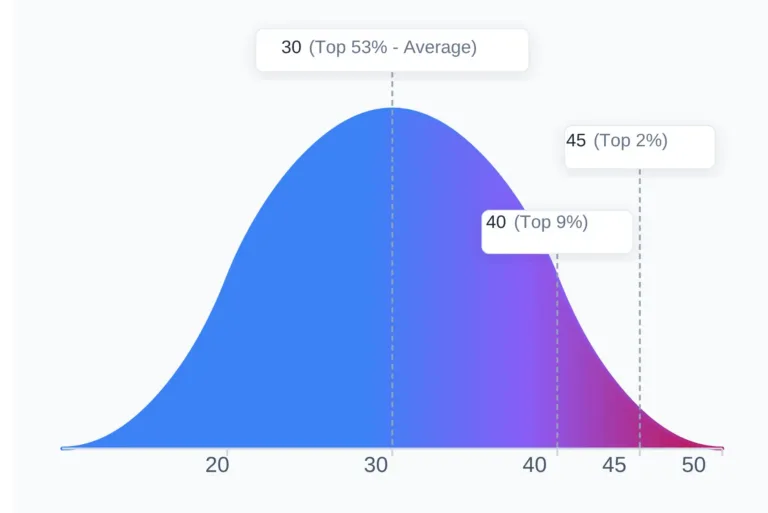
VCE raw study scores are distributed along a normal bell curve, demonstrating how drastically the competition increases to achieve scores of 40 and above.
How and why VTAC scales VCE subjects
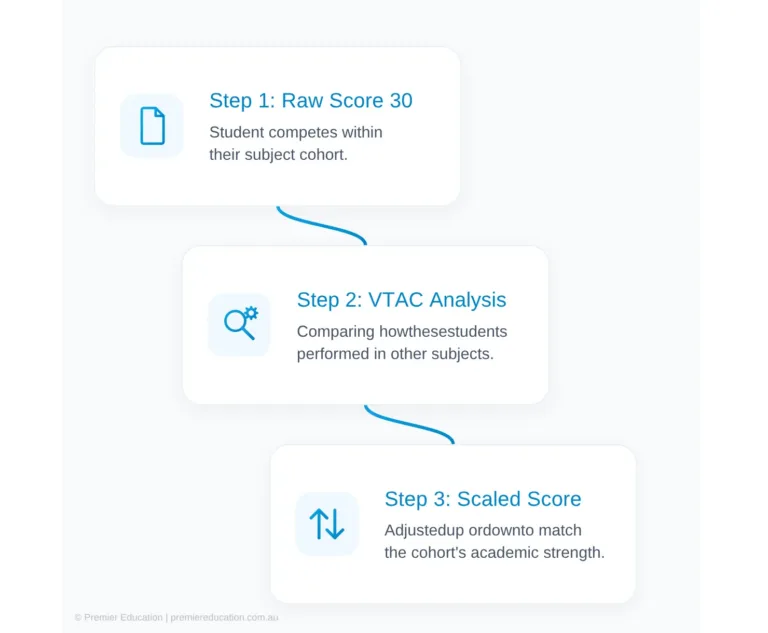
VTAC scales VCE study scores to ensure a fair comparison between students taking different combinations of subjects. Scaling adjusts for the competitiveness of the student cohort, not the inherent difficulty of the subject curriculum itself.
If the data shows that students taking VCE Chemistry generally perform significantly higher across all their other subjects, Chemistry is considered a highly competitive cohort.
To prevent these students from being unfairly disadvantaged by competing against each other, their raw study scores are scaled up. Conversely, if a subject’s cohort performs lower in their other subjects, scores may be scaled down.
Ultimately, scaling equalises the playing field so that a scaled 30 in one subject represents the same level of academic achievement as a scaled 30 in any other subject, allowing universities to rank graduates fairly.
The risk of chasing VCE scaling
One of the most common pitfalls for students is choosing a subject solely because it ‘scales up’, under the mistaken belief that the curriculum rewards difficulty.
As outlined in the VTAC ATAR and Scaling Guide, choosing a subject you struggle with just for scaling will usually result in a lower overall contribution to your ATAR.
There are, however, a few specific structural adjustments to be aware of. Government policy encourages language studies by adding five points to the initial VTAC scaled average (though this impact tapers off slightly for students scoring at the high end).
Additionally, mathematics subjects are scaled against one another to reflect their distinct hierarchy, acknowledging VCE Specialist Mathematics as the most competitive, followed by VCE Mathematical Methods, then VCE General Mathematics.
The VTAC scaling process evaluates the overall academic strength of a subject’s cohort to ensure no student is disadvantaged by choosing highly competitive classes.
What are the VTAC subject selection rules for mathematics?
When calculating your final aggregate, VTAC applies strict study area grouping restrictions to ensure students maintain a diverse VCE program. These consist of:
- A maximum of two subjects from the same study area can be included in your primary four calculation
- At most, three subjects from the same area can contribute to your ATAR in total
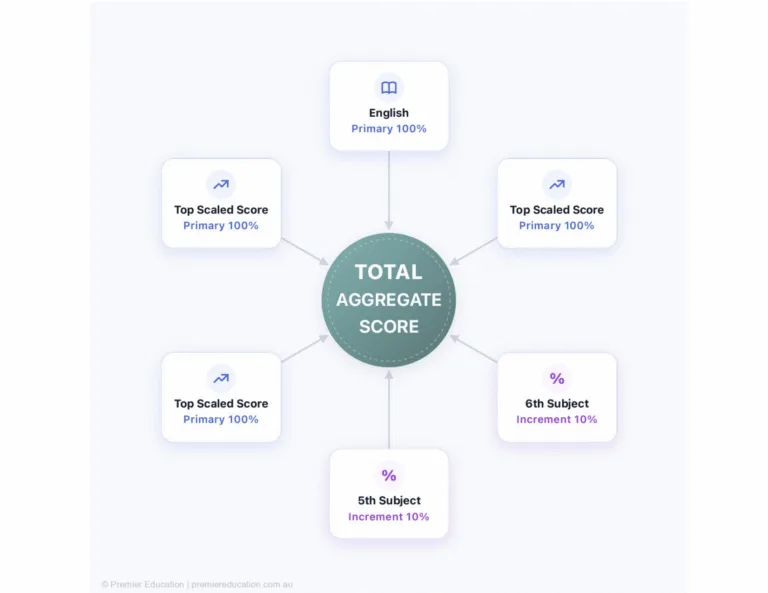
How VCE maths subject choices affect your final rank
These rules impact students taking three mathematics subjects, such as VCE General Mathematics, VCE Mathematical Methods, and VCE Specialist Mathematics.
Because only two can sit in the primary four, the lowest scoring of the three mathematics subjects is automatically forced to become a 10 per cent increment.
This happens regardless of how highly it scores compared to your other non-maths subjects. Strategic subject selection is therefore vital to maximising your final rank and avoiding unintentional penalties to your aggregate.
A smarter approach to VCE subject selection
At Premier Education, we frequently consult with families who are considering taking three maths subjects. While strong quantitative students may enjoy the curriculum, the structural reality of the VTAC system means one of those subjects will be severely diminished in the final calculation.
Instead of taking three maths subjects and forcing one to become an increment, consider substituting your weakest maths for a high-scaling language or science to protect the value of your primary four.
Students should build a subject portfolio that complements their strengths while safely spreading across different study areas to ensure their hardest work yields 100 per cent of its potential value.
If you need further support, we have elite maths tutors for each of these subjects. Whether your child needs help preparing for SACs, exams, or building stronger fundamentals, our experienced team provide structured, results-driven maths tutoring tailored to every level.
How are the aggregate and final ATAR calculated?
Your ATAR is a percentile ranking derived from your final aggregate score. VTAC calculates this using two components:
- Primary Four: Your highest-scoring English subject plus your next three highest scaled scores
- Increments: Exactly 10 per cent of your fifth and sixth highest scaled scores
The maximum possible aggregate can exceed 210. Once every year, 12 students’ aggregate score is calculated, and they are arranged in numerical order on a percentile scale.
This final ranking determines your ATAR. Because it is a percentile ranking, an ATAR of 90.00 means your aggregate was higher than 90 per cent of your relevant Year 7 age cohort, placing you in the top 10 per cent.
Aggregate calculation in action
To demonstrate how the primary four and increments work together, consider these two distinct student case studies and their calculated aggregates.
Student one: Breaking down an arts and commerce pathway
| Subject | Raw Score | Scaled |
|---|---|---|
| English | 45 | 45 |
| Economics | 45 | 46 |
| Business Management | 45 | 44 |
| Drama | 45 | 43 |
| Health and Human Development (10%) | 43 | 40 |
| Primary Aggregate | 178.0 (Primary) + 4.0 (Increment) | |
| Final Aggregate | 182.0 | |
| Approx. ATAR | ~97.70 |
Student two: See how maths and science differ
| Subject | Raw Score | Scaled |
|---|---|---|
| English | 40 | 39 |
| Specialist Maths | 40 | 51 |
| Maths Methods | 40 | 46 |
| Chemistry | 40 | 44 |
| Biology (10%) | 40 | 41 |
| Calculation | 180.0 (Primary) + 4.1 (Increment) | |
| Final Aggregate | 184.1 | |
| Approx. ATAR | ~98.05 |
*Approximate ATARs are based on the official 2025 VTAC Aggregate to ATAR data (or similar).
The strategic takeaway: Passion vs. scaling
Look closely at the raw scores of these two students.
Student one achieved an extraordinary string of raw 45s, meaning they placed in the top two per cent of the state across almost all their subjects. Student two achieved raw scores in the 40s, placing them in the top nine per cent of the state.
Despite Student One technically outperforming Student Two in raw percentiles across the board, Student Two walked away with a higher aggregate and final ATAR.
Because Student Two chose a highly competitive, mathematically rigorous subject combination (Specialist Maths, Maths Methods, and Chemistry), VTAC’s scaling adjustments heavily rewarded their aggregate.
The reality of VCE scaling
This illustrates a harsh but vital reality of the VCE system: while you should absolutely pursue subjects you enjoy, selecting subjects based purely on passion without considering the mathematical implications of scaling can put a ceiling on your ATAR.
At Premier Education, we strongly advise that elite subject selection must be strategic. By balancing subjects you are passionate about with heavy-hitting, high-scaling subjects, you maximise your ATAR return on investment.
If you need support applying this strategy, our experienced VCE tutors in Melbourne can provide personalised guidance across subject selection and performance.
Landmark aggregates for 2025
Having a target aggregate gives students a tangible goal. Based on the official VTAC 2025 Scaling Report, the minimum scaled aggregates required for key landmark ATARs were:
| Target ATAR | Minimum Scaled Aggregate |
|---|---|
| 99.90 | 208.08 |
| 99.50 | 198.20 |
| 99.00 | 192.10 |
| 95.00 | 169.85 |
| 90.00 | 155.19 |
| 80.00 | 135.65 |
Your final aggregate is constructed heavily from your Primary four subjects, meaning your top four performing classes carry the vast majority of the weight for your final ATAR.
How to maximise your VCE ATAR
Securing an elite ATAR requires outperforming the state average in speed and application. As established, achieving a study score of 40 or above requires performing in the top nine per cent of the state.
Because of this mathematical reality, simply finishing the syllabus right before exams is insufficient.
This is the Premier Education advantage. Most high schools finish their VCE curriculum in late October, leaving limited time for dedicated exam preparation. Our small-group classes expose students to competition early, pushing them to excel by showing the calibre at which other top students operate.
Accelerated VCE learning for a competitive edge
Our accelerated programs are explicitly designed to secure your competitive edge through several key pillars:
- Accelerated pacing: We finish the core VCE curriculum by July or August, reclaiming months of valuable time that standard school pacing loses.
- Dedicated exam conditioning: Students spend a full two to three months on high-intensity exam revision and past-paper conditioning.
- Elite tutors: You are guided by VCE tutors who have been through this exact process and come out at the very top of the state, teaching crucial exam strategy and application alongside the syllabus.
Completing the VCE curriculum early allows for months of dedicated exam strategy, giving students a crucial edge over the state average.
Common VCE scaling and subject selection questions answered
1. Can I get an ATAR without doing English?
No. Your highest-scoring VCE English subject, whether that is mainstream English, Literature, English Language, or English as an Additional Language (EAL), must be included in your primary four subjects to calculate a valid aggregate and receive an ATAR.
2. Do VCE Vocational Major (VM) subjects get a study score?
No. VCE Vocational Major (VM) subjects are highly valuable for specific career pathways, but they do not receive a standard VCE study score. Consequently, they cannot be used in the calculation of an aggregate or an ATAR.
What happens if I do three VCE Maths subjects?VTAC rules dictate that a maximum of two subjects from the same study area can sit within your primary four. Therefore, your lowest-scoring third maths subject will automatically be reduced to a 10 per cent increment, regardless of how well you perform in it compared to your other non-maths subjects.
3. What is a perfect VCE aggregate score?
Because certain highly competitive subjects (such as Specialist Mathematics or rigorous Language studies) can scale above the raw cap of 50, up to a maximum of 55, the highest VCE aggregates each year exceed 210 points.
4. Does VCE General Maths scale down?
Yes, typically General Mathematics does scale down slightly. This is because VTAC scaling adjusts for the competitiveness of a subject’s cohort rather than syllabus difficulty.
Subjects like Mathematical Methods and Specialist Mathematics are scaled higher to account for their highly competitive student cohorts. However, performing exceptionally well in VCE General Maths will still yield a strong contribution to your final aggregate.
Maximise your VCE ATAR with tailored VCE tutoring
Navigating VCE scaling and aggregate rules is crucial, but executing a flawless academic strategy is what ultimately secures the results.
Not sure if your current subject selection is maximising your ATAR potential? Download our Student Handbook to map out your optimal path.
VCE is a competition, and getting ahead of the curve is the only reliable way to the top. If you’re interested in maths tutoring or need support across subjects like VCE physics, VCE chemistry, and VCE biology, our experienced VCE tutors are here to help.
Book a free assessment and trial with Premier Education today to secure your spot in our accelerated small-group classes and finish your curriculum months ahead of the state.
Author
Premier Education
Our team of tutors have achieved perfect 99.95 ATARs, perfect 50 study scores, and have accumulated over 20 years of combined tutoring experience. We have made it our personal mission to not only help you succeed in Mathematics and English, but become well rounded students equipped to face any challenge in life.