
May 30, 2026
How to Study for VCE Maths Methods SACs: The Pre-Learning Cycle

To secure high marks in VCE Maths Methods, it might help to abandon the traditional cramming timeline and adopt a pre-learning cycle that shifts initial learning to weeks before the classroom lesson. You must align your preparation with the official VCAA VCE Mathematical Methods Study Design, mastering foundational routines early so they can focus entirely on high-level application.
In this guide, we’ll explain how students can stay ahead of the school syllabus, structure their SAC preparation more effectively, and use targeted Maths Methods tutoring to improve confidence and performance throughout the year.
Do you need support to stay ahead in VCE Maths Methods? At Premier Education, our experienced VCE Maths Methods tutors help students prepare through structured learning, practice questions, and targeted academic support. Your first lesson is free.
Why Does the Traditional Study Model Fail in VCE Maths Methods?
To get high marks in VCE Maths Methods SACs, you must avoid last-minute cramming and adopt a pre-learning cycle. The VCE Mathematical Methods Study Design explicitly demands the application of mathematical processes in non-routine contexts. You cannot bridge this gap if you are still memorising foundational formulas.
VCAA Assessment Expectations: Outcome 1 vs Outcome 2
| Expectation | Focus |
| Outcome 1 | Routine procedures, foundational knowledge, and basic understanding of rules. |
| Outcome 2 | Application of mathematical processes in non-routine contexts, including modelling and problem-solving. |
In junior years, testing relies primarily on basic understanding, allowing students to succeed by cramming textbook exercises.
However, the most successful VCE students master core concepts two to three weeks before they are taught in school. This strategy ensures the immediate pre-SAC period is dedicated entirely to practising SACs and differentiator questions, moving from basic comprehension to advanced problem-solving.
You cannot apply non-routine mathematical modelling if your cognitive load is still consumed by recalling basic formulas. If you finish the curriculum syllabus just two days before your SAC, you leave yourself no time to attempt the open-ended application questions that actually distinguish high achievers.
What is the Ideal Timeline for VCE Maths Methods SAC Preparation?
The most effective way to prepare for VCE Maths Methods SACs is to pre-learn the curriculum. We recommend targeting a partial understanding at home two to three weeks prior to the school lesson. Undertaking this initial learning in a low-stakes, supportive environment removes the pressure of immediate perfection.
- Phase 1: Home Pre-Learning
Wrestle with the core concepts and syntax at home weeks ahead of time, accepting that partial understanding is normal. Target a 30-40% understanding rate, which we call the Premier Education Pre-Learning Baseline. This pre-learning is best executed via tutoring that strictly targets Outcome 1, freeing up your school time for Outcome 2. For example, if you are learning polynomial transformations, focus only on understanding the basic syntax and visual shift two weeks before the teacher introduces it. - Phase 2: School Consolidation
Transform your school classes from a stressful reveal into a strategic review to patch knowledge gaps. - Phase 3: Pre-SAC Application
Keep your final preparation window clear of basic textbook exercises so you can immerse yourself entirely in differentiator questions.
The Psychological Benefits of Pre-Learning
- Normalising the struggle: When first encountering complex topics like the calculus of transcendental functions, aim only for syntax comprehension. Expecting perfect understanding on the first pass is unrealistic. Accepting partial understanding on your first pass eliminates the anxiety of falling behind.
- Secondary consolidation: When you learn the material ahead of time, the school classroom ceases to be your primary learning environment. Instead, it becomes a secondary consolidation space. Hearing the teacher explain a concept you have already wrestled with makes the underlying logic click significantly faster.
By completing textbook exercises during your school review phase, you reserve your final week exclusively for timed practice SACs.
How Should You Practice for Maths Methods SACs?
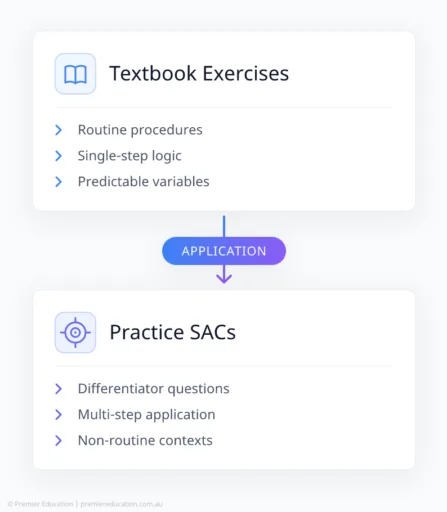
Preparing for a VCE Maths Methods SAC requires a fundamental shift from standard textbook exercises to realistic practice SACs. While textbooks are excellent for building foundational understanding and routine skills, they rarely reflect the difficulty or non-routine contexts of actual VCAA assessments.
VCE SACs are strictly designed with differentiator questions that test your ability to apply knowledge to unseen, complex scenarios. If your only revision is textbook chapter reviews, you will be unprepared for the differentiator questions in an actual SAC.
How to Structure Your Final Week of Maths Methods SAC Preparation
In the final week before your SAC, your sole focus should be on completing practice SACs under tight, timed conditions. This intensive final week of pure practice is only possible because you front-loaded your learning weeks in advance.
Because mathematical questions rarely repeat, practice must focus on identifying underlying patterns and applying mathematical formulations to novel contexts.
| Feature | Textbook Exercises | Practice SACs |
| Primary Goal | Teach foundational rules and formulas. | Test application and adaptability. |
| Question Structure | Single-step logic, heavily guided. | Multi-step logic, open-ended parameters. |
| Predictability | High. Context aligns exactly with the chapter. | Low. Combines multiple concepts into unseen scenarios. |
| Timing | Untimed, low-stress environment. | Completed strictly under SAC time limits. |
Timed practice assessments simulate exam constraints and build the stamina required for Tech-Active assessments. Mathematical questions at the VCE level will always feature new variables and unique contexts.
By heavily weighting your revision toward practice SACs, you stop trying to memorise the exact wording of a problem and instead learn to trust your ability to apply mathematical modelling to any given scenario.
Why is Supervised Feedback Critical for Methods SACs?
Completing practice questions without supervised feedback can actively harm your VCE Maths Methods scores by hardwiring incorrect mathematical reasoning. According to the VCAA VCE Mathematical Methods Assessment Reports, correct answers must be supported by correct working; the final numerical answer typically only awards a single mark, with the majority of marks allocated to the working and reasoning.
Textbooks usually provide only the final numerical answer, leaving students guessing whether their methodology satisfies rigorous VCAA standards.
To truly improve, you need to access comprehensive marking guides and, ideally, support from a VCE Maths Methods tutor who can carefully assess your work. Targeted, individualised feedback completely closes the learning loop and ensures that you explicitly communicate your mathematical reasoning.
It is far more valuable to complete 10 practice questions with expert correction than 50 questions entirely on your own. When you work without oversight, you risk hardwiring methodological errors into your memory.
Where VCE Examiners Allocate Marks:
| The Mistake | The VCAA Expectation | The Premier Education Fix |
| Ignoring constraints | Clearly specifying the applicable domain for a given function or mathematical model. | Line-by-line working-out feedback to ensure domains are explicitly stated. |
| Informal notation | Using the correct brackets and mathematical syntax to represent ranges, intervals, and subsets. | Detailed, individualised corrections on syntax and set notation during practice SAC reviews. |
| Calculator reliance for working | Demonstrating the logical progression of equations step-by-step rather than skipping straight to a calculator output. | Step-by-step worked solutions demonstrating Tech-Free and Tech-Active requirements. |
To solve this, an effective study methodology requires submitting practice SACs for rigorous correction against VCAA examiner expectations. Having your work audited by an expert stops bad habits before assessment day.
How Should You Use a CAS Calculator in Tech-Active SACs?
Proficiency with your Computer Algebra System (CAS) calculator is a mandatory skill for high achievement in VCE Maths Methods Tech-Active SACs. The VCAA curriculum specifically assesses computational thinking and the effective use of numerical, graphical, and symbolic functionalities of technology (Outcome 3).
The CAS calculator is fundamentally designed to save you time. If a question is on a Tech-Active assessment and does not explicitly say ‘show that’ or require by-hand working, calculating the steps manually wastes valuable exam time.
High-scoring students know exactly when to rely on their calculator.
By-Hand vs. CAS Calculator
| Mathematical Task | Tech-Free SAC Approach | Tech-Active SAC Approach |
| Solving complex polynomials | Factorise using the factor theorem and polynomial division by hand. | Use the solve() or zeros() functions to bypass lengthy manual algebraic manipulation. |
| Finding intersection points | Set equations equal to each other and solve algebraically. | Execute simultaneous equation solvers and graph both functions to visually confirm solutions. |
| Computing probability distributions | Manually evaluate binomial formulas or apply normal distribution symmetry properties. | Use built-in statistical functions like normCdf() or binomPdf() for instant, accurate computation. |
Your CAS calculator is not a crutch; it is a necessary tool for managing the strict time constraints of Exam 2 and Tech-Active assessments. Attempting to navigate menus for the first time during a SAC is a guaranteed way to lose marks.
You must integrate technology into your daily study routine. Practise executing specific button flows so that your actions become automatic.
Furthermore, pay close attention to the VCAA requirements outlined for Outcome 3, which mandates distinguishing between exact and approximate presentations of mathematical results. Incorrectly providing approximate solutions when exact values are required is a frequent stumbling block that costs students critical marks.
Answering Your Frequently Asked Questions About Methods Tutoring
1. Is Maths Methods good for my ATAR?
Yes. Maths Methods is a high-scaling subject, meaning strong scores can boost your ATAR above your raw study score. It’s also a prerequisite for many university courses, making it doubly valuable.
2. Do SACs affect my ATAR?
Yes. SACs contribute to your school-assessed coursework score, which is moderated against your exam performance and counts toward your final study score. Doing well in SACs gives you a strong foundation going into exams.
3. How many SACs are there in VCE Maths Methods?
The VCAA prescribes an extended application task for Unit 3 (allocated 50 marks total), and two modelling or problem-solving tasks for Unit 4 (also allocated 50 marks total). However, many schools choose to split these into smaller, more frequent assessments.
4. How do I get a high score in Maths Methods?
Achieving a high score requires adopting a pre-learning strategy to build foundational understanding weeks in advance. You must then use your school classes for strategic review, heavily weighting your final preparation toward practice SACs and non-routine application questions.
5. Why am I failing Maths Methods when I understand the textbook?
Textbooks primarily test basic comprehension and routine questions. In contrast, VCE Methods SACs test your ability to apply mathematical concepts to unseen, non-routine scenarios. Understanding the rules is only the first step; you must actively practise applying them to complex problems.
6. Are final answers enough to get full marks in VCE Maths Methods?
No. The final numerical answer typically only awards a single mark, with the majority of marks allocated to the working and reasoning. In complex questions, these marks are awarded for clearly demonstrating your mathematical reasoning, correct syntax, and step-by-step working out.
7. What does Premier Education’s Maths Methods tutoring program include?
Our tutoring programs include small group interactive sessions, structured notes, practice SACs, progress testing, and ongoing support from experienced VCE Maths Methods tutors who understand VCAA expectations.
8. Can I try VCE Maths Methods tutoring before enrolling?
Yes. We offer a free assessment, trial class, and marked practice SACs with personalised feedback so students can experience the program before committing.
Start Maths Methods Tutoring Before SAC Stress Takes Over
Struggling to find practice SACs with full working-out solutions? Sign up for a Free Assessment and experience the Premier Education standard today.
Stop letting SACs be a stressful reveal. Join Premier Education’s accelerated program to master the curriculum weeks before your classmates. Whether you’re looking for a VCE Maths Methods tutor, a VCE specialist maths tutor, or structured support to stay ahead, Premier Education can help you build confidence before assessment day. Book your free assessment and trial to secure your advantage.
Author
Premier Education
Our team of tutors have achieved perfect 99.95 ATARs, perfect 50 study scores, and have accumulated over 20 years of combined tutoring experience. We have made it our personal mission to not only help you succeed in Mathematics and English, but become well rounded students equipped to face any challenge in life.