
May 21, 2026
Am I Ready for VCE Maths Methods? A Guide to the Year 10 Transition

VCE Maths Methods is widely considered one of the most demanding mathematics subjects in the Victorian curriculum.
To succeed, students must master specific algebraic baselines before Year 11, begin preparation early enough to stay two weeks ahead of the syllabus, and intervene with targeted Maths Methods tutoring the moment School-assessed Coursework (SAC) scores drop.
In this guide, we’ll cover what separates students who thrive in Methods from those who fall behind, when to start preparing, and how to intervene before a bad SAC score becomes a pattern.
Do you need support to get ahead in VCE Maths Methods? At Premier Education, our Maths Methods tutors have achieved perfect study scores and bring hands-on experience to help you get there, too. Your first lesson is free.
Is VCE Maths Methods Hard?
The difficulty of VCE Maths Methods lies in its heavy focus on application over simple understanding. To succeed, students must transition from simply knowing how to perform a mathematical operation to critically deconstructing complex, worded problems.
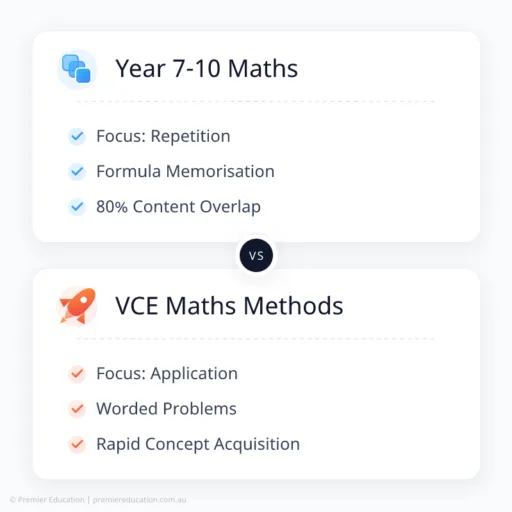
The primary difference between junior maths and VCE Maths Methods lies in the shift from rote repetition to critical problem-solving and application.
| Feature | Year 7-10 Maths | VCE Maths Methods |
| Core Focus | Repetition and formula memorisation | Critical problem-solving and application |
| Content Progression | Highly cyclical (80% content overlap each year) | Rapid conceptual leaps and acquisition |
| Assessment Style | Predictable, procedural questions | Complex, worded modelling scenarios |
| Exam Scenario | Abstract, standalone equations | Unfamiliar contexts (e.g., an object in motion) requiring independent tool selection |
The Diagnostic Angle: The Year 10 to Year 11 Transition
The transition from Year 10 maths to VCE Maths Methods Units 1 and 2 is the most significant jump in high school. Throughout junior years, the mathematics curriculum is highly cyclical. In contrast, Maths Methods introduces rapid, non-repeating conceptual leaps.
Students often experience a shock when transitioning into Year 11, as the comfortable repetition of junior maths is replaced by learning new material at every turn.
While the year begins in comfortable territory with straight lines and parabolas, it soon accelerates into unfamiliar algebraic, probability and calculus concepts.
Unit 1, Area of Study 2 demands that students fluently solve polynomial equations numerically, graphically, and algebraically.
Year 11 Baselines
| Baseline Concept | Required Year 11 Application |
| Linear Algebra | Rapid rearrangement and solving of simultaneous equations without reliance on a calculator. |
| Quadratics | Instant recognition of factorisation patterns, the quadratic formula, and the discriminant. |
| Coordinate Geometry | A strong grasp of plotting points, calculating gradients, and understanding the Cartesian plane. |
What Skills do I Need for Maths Methods Units 3 and 4?
To succeed in VCE Maths Methods Units 3 and 4, students must possess an airtight foundation in the concepts covered during Units 1 and 2. Because Year 12 Methods is a direct extension of Year 11, the transition is gentler, provided you have mastered the fundamentals.
Core concepts like domains, ranges, and transformations are not isolated chapters; they are the fundamental tools required to solve advanced calculus and probability questions in Year 12.
The critical skills required are a deep understanding of functions, domains, ranges, and transformations. The VCAA Study Design outlines the need to master specific graphs, including polynomials, power functions, exponentials, logarithmic functions, and circular functions.
However, students frequently make the mistake of treating these as isolated topics. Domains, ranges, and transformations are not separate chapters you can forget after a test; they are the structural vocabulary used to ask questions about calculus and statistics later in the year. Without them, learning gaps quickly compound.
The Universal Rule for VCE Maths Methods: If Unsure, Graph it
The ability to visualise and graph functions is critical; sketching a worded problem often reveals the algebraic solution that numbers alone obscure. The VCAA explicitly mandates the graphical representation of functions from Unit 1, making this a foundational survival skill, not just a late-stage exam trick.
Unfamiliar algebraic fractions are notoriously difficult to interpret without a visual model. Sketching a quadratic instantly reveals the optimal dimensions or maximum profit that abstract algebra obscures.
The moment you sketch that equation, the behaviour of the function becomes obvious. Visualisation bridges the gap between abstract numbers and tangible solutions.
Preparation Timelines: When Should I Study VCE Maths Methods?
Deciding when to prepare for VCE Maths Methods depends entirely on a student’s current mathematical baseline.
At Premier Education, we operate on a core philosophy: the first time you learn a complex concept is always the hardest. You should never learn new material just days before an assessment.
Staying ahead of the school curriculum ensures that classroom time is used for consolidation rather than stressful, first-time learning.
The danger of traditional study is encountering difficult calculus or probability concepts for the very first time on a Tuesday and being tested on them by Friday. The cognitive load is simply too high. Consider these two primary timelines for success:
| Student Profile | Recommended Timeline Strategy |
| High Achievers (Accelerated) | If Year 10 maths feels redundant, accelerate into Units 1 and 2 early. This leverages the ‘first time is the hardest’ principle by ensuring you absorb these lessons in a supportive space, removing the pressure of the Year 11 jump. |
| Standard Enrolment | If completing the subject in the normal timeframe, the goal is proactive pre-learning. Arriving at a school lesson having already wrestled with the core concepts means you spend the teacher’s instruction time resolving your specific confusion, rather than scrambling to take introductory notes. Aim to stay two to three weeks ahead. |
The Intervention Angle: When to Start Maths Methods Tutoring
The best time to start VCE Maths Methods tutoring is before a student falls behind, ideally through a proactive head start in Year 10. If a student is already enrolled, immediate intervention is strictly required when clear academic warning signs appear during classroom lessons or school assessments.
While school assessments are designed to separate and rank students, a strategic tutoring intervention is designed to elevate a student’s application skills to meet those demands.
Unlike textbook exercises, VCE SACs are intentionally designed to assess application under pressure to rank the cohort. An effective Methods tutor shifts the focus from simply completing textbook exercises to improving a student’s application skills, pushing them beyond standard classroom examples.
Intervention is necessary if you notice any of these three objective warning signs:
- Paralysis on worded questions. The student can easily solve an abstract equation but freezes when asked to calculate the dimensions of a physically modelled bridge.
- Classroom disconnect. The teacher’s explanations consistently feel too fast or presume knowledge the student does not have.
- SAC score shock. The student feels they studied hard and completed the chapter questions, but still received a highly disappointing SAC result.
Your Maths Methods Questions Answered
1. What is a VCE SAC?
School-assessed Coursework (SACs) are moderation tools designed to rank a cohort’s application skills, rather than pass/fail tests of basic textbook knowledge.
2. Do I need to be good at geometry for VCE Maths Methods?
While not a standalone geometry course, a basic understanding of coordinate geometry and geometric constructions is assumed knowledge.
You will consistently need these fundamentals to successfully solve complex graphical problems, interpret transformations, and navigate spatial reasoning tasks throughout the VCE syllabus.
3. Can I do Maths Methods Units 3 and 4 without doing Units 1 and 2?
Technically, you are allowed to enrol in Units 3 and 4 without completing Units 1 and 2, but it is strongly advised against. The VCAA Study Design explicitly dictates:
‘Assumed knowledge and skills for Mathematical Methods Units 3 and 4 are contained in Mathematical Methods Units 1 and 2, and will be drawn on, as applicable.’
Attempting the Year 12 syllabus without this foundation would be highly challenging.
4. What is the most important skill for Methods final exams?
The ability to visualise and graph functions is the single most critical skill for the final exams. Sketching a worded problem or an abstract equation often reveals the logical algebraic solution that numbers alone obscure.
If you are ever unsure during an exam, your first step should be to graph it.
5. Should I accelerate Maths Methods in Year 10?
If you are a high achiever who finds Year 10 maths comfortable, starting Methods Units 1 and 2 a year early provides a massive advantage.
It eases the most difficult academic transition in high school by allowing you to absorb complex new concepts in a low-stakes, highly supportive environment.
6. What does Premier Education’s Maths Methods tutoring program include?
Premier Education’s Maths Methods tutoring combines small group interactive sessions, comprehensive notes, and a curated library of practice SACs and progress tests. Students also get 24/7 support through the Premier One portal.
7. Can I try VCE Maths Methods tutoring before committing?
Yes. Premier Education offers a free trial class, free assessment, and a free marked Practice SAC with personalised feedback, all with no strings attached.
Start VCE Maths Methods Tutoring now and get Ahead
By understanding the shift from rote learning to active application, mastering core algebraic baselines before Year 11 begins, and staying consistently ahead of the school syllabus, students can navigate this demanding subject with confidence.
Don’t wait until the first SAC to find out you’re behind. At Premier Education, we offer VCE math tutoring from people who have already mastered it, with perfect ATARs and study scores to prove it, so you’re never navigating Maths Methods alone.
Sign up for a free Maths Methods Practice SAC and consultation with Premier Education today, and let us build your personalised timeline for VCE success.
Author
Premier Education
Our team of tutors have achieved perfect 99.95 ATARs, perfect 50 study scores, and have accumulated over 20 years of combined tutoring experience. We have made it our personal mission to not only help you succeed in Mathematics and English, but become well rounded students equipped to face any challenge in life.