
April 17, 2026
The VCE GAT explained: What it is, how it affects your ATAR, and if you should study

The General Achievement Test (GAT) is a mandatory Victorian assessment used to statistically moderate school-based marks and calculate substitute scores if you fall ill during final exams.
It serves as a vital academic insurance policy that protects your final ATAR if the unexpected happens.
In this article, we explain everything you need to know so that you feel confident moving forward. Discover who the VCE GAT is for, how it’s used, how it moderates your SACs, and more.
Interested in preparing for the VCE GAT or looking for tailored support in a specific subject? At Premier Education, we help students build confidence, strengthen their skills, and work towards their ATAR goals with focused, high-quality VCE tutoring.
What is the VCE GAT, and who needs to sit it?
The General Achievement Test (GAT) is a compulsory statewide assessment that measures foundational literacy, numeracy, and reasoning skills rather than specific Year 12 subject content.
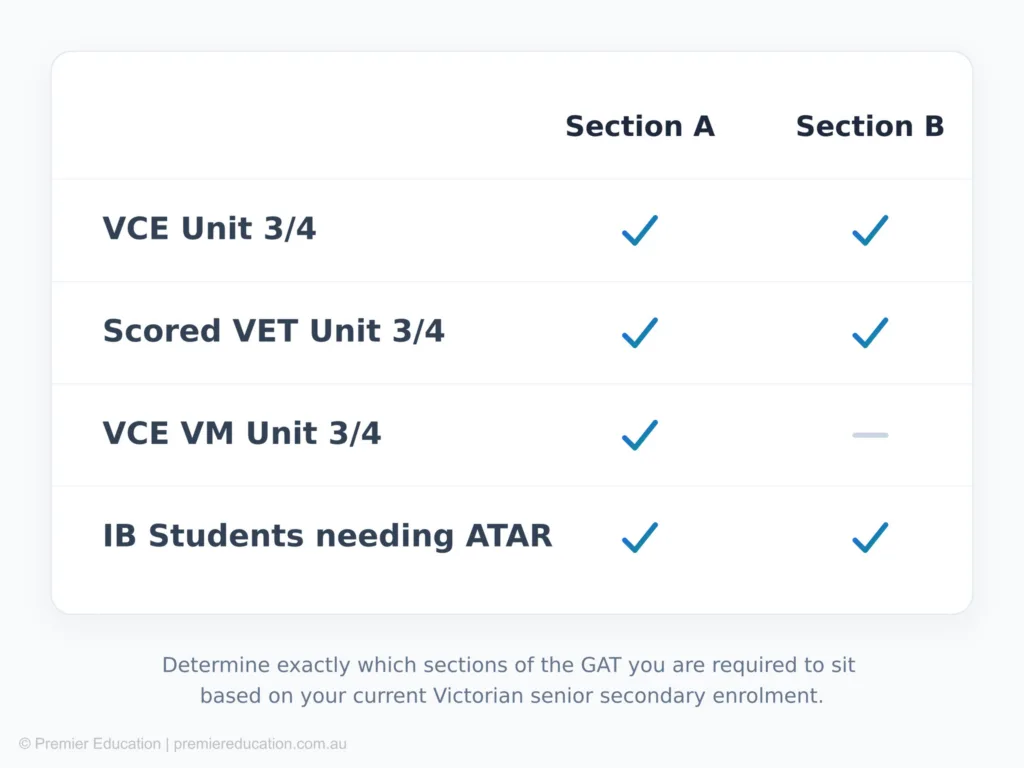
Students enrolled in any VCE or scored VCE VET Unit 3 to 4 sequence must sit both sections, while VCE Vocational Major (VM) students complete Section A only.
The GAT takes place annually in mid-June. The Victorian Curriculum and Assessment Authority (VCAA) uses it as a quality assurance tool, not a pass-or-fail exam.
Can you get an exemption from the VCE GAT?
The VCAA will grant exemptions from the GAT only in severe circumstances, such as major medical emergencies, personal trauma, or serious intervening events (such as an accident on the morning of the exam).
Any application for exemption must be supported by independent professional evidence submitted directly through your school.
What is the GAT used for in Victoria?
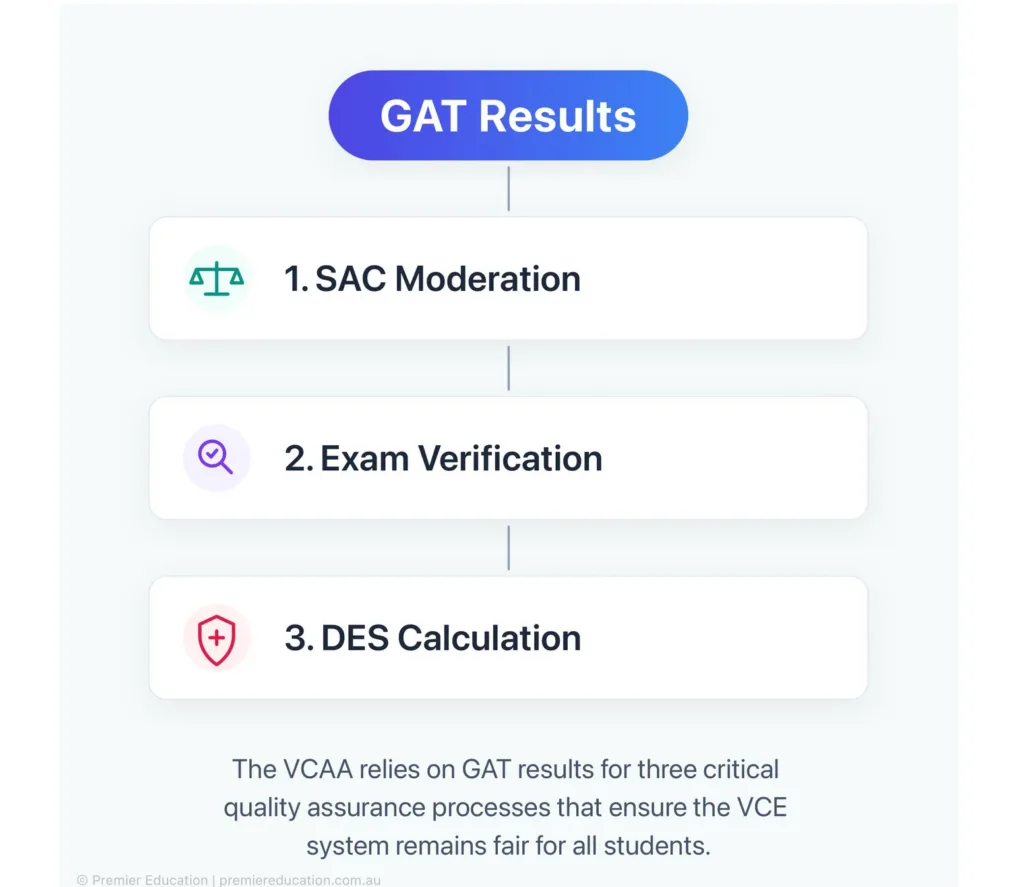
In Victoria, the VCAA uses the GAT for three primary administrative purposes: to ensure statistical moderation of school-based assessments, verify external end-of-year examination results, and calculate substitute Derived Examination Scores (DES) for students who experience severe illness or personal trauma.
- Statistical moderation of school-based assessments
The VCAA compares a school’s internal marks against its students’ GAT performance to adjust scores. This prevents schools from grading too harshly or too leniently, levelling the playing field. - Verifying external assessment results
The GAT acts as a final quality assurance check for end-of-year exams. If your final exam score is significantly lower than your GAT performance predicts, the exam is automatically reassessed by a chief assessor. - Calculating Derived Examination Scores (DES)
If you experience a severe illness or personal trauma during final exams, your GAT component scores are used mathematically to generate a fair, alternative score, protecting your final ATAR.
See how the GAT keeps SAC marking fair with statistical moderation
Internal School-Assessed Coursework (SACs) is marked by your own teachers, meaning their difficulty varies between schools. If one high school writes an exceptionally difficult English SAC paper, its students might average a 60 per cent mark.
Another school might write a very easy paper, where their students average 90 per cent. By comparing how both cohorts perform on the exact same state-wide GAT, the VCAA uses statistical moderation procedures to confidently scale internal SAC marks so that no student is disadvantaged.
During verification by a chief assessor, your score can only go up or remain the same. It will never be downgraded.
Does the GAT affect your ATAR and study scores?
The GAT does not directly contribute points to your final ATAR or individual study scores. However, it indirectly impacts your results by acting as a standardisation tool to scale your internal coursework marks and serving as a powerful academic safety net.
Because the VCAA uses GAT results to statistically moderate School-Assessed Coursework (SACs), a strong overall school performance on the GAT can help scale up internal marks, ensuring students are not disadvantaged by harsh school grading.
How the VCE GAT protects your ATAR score
More importantly for individual students, the GAT protects your ATAR through the Derived Examination Score (DES) system. The GAT serves as a vital academic insurance policy.
Think of the GAT as your ATAR’s airbag. You hope you never need it, but if a serious intervening event occurs on the morning of your exam, you will be incredibly grateful it is there to absorb the impact.
If you contract a severe virus like COVID-19 the week of your final exams and cannot attend, you will have to rely on a Derived Examination Score (DES).
If you took the GAT seriously earlier in the year, the VCAA has a high-quality data point to accurately predict what you would have scored on that exam, keeping your hard-earned ATAR intact. If you do not make a genuine attempt on the GAT, the VCAA lacks the data required to calculate an accurate substitute score, compromising your safety net.
How is the VCE GAT structured and scored?
The GAT is a rigorous, four-hour paper-based exam divided into two distinct parts. Students receive a standardised score for each component, along with a statement indicating whether they have met, not met, or exceeded the Victorian Literacy and Numeracy Standards.
GAT section A: literacy and numeracy breakdown
Section A runs for 135 minutes (plus 15 minutes of reading time) and focuses on foundational literacy and numeracy skills.
The VCAA recommends targeting 30 minutes for a two-part writing task, 45 minutes for 50 reading multiple-choice questions, and 45 minutes for 50 numeracy multiple-choice questions.
GAT section B: general knowledge and reasoning skills
Section B runs for 105 minutes (plus 15 minutes of reading time) and assesses broader general knowledge and skills applied in daily life.
The VCAA recommends allocating 30 minutes to an extended writing task, 30 minutes to 25 multiple-choice questions in mathematics, science, and technology, and 30 minutes to 25 multiple-choice questions in arts and humanities.
What to keep in mind for the VCE GAT
Section A requires an informative, synthesised piece based on visual stimuli, while Section B requires a personal perspective piece based on prompts.
When you receive your GAT Statement of Results, you will see your performance clearly broken down. Importantly, marks are never deducted for incorrect answers in the multiple-choice sections.
If you are running out of time, it is always in your best interest to guess rather than leave a bubble blank on the answer sheet.
Should you study for the VCE GAT?
You cannot study for the GAT in the traditional sense, as it tests general reasoning rather than memorised VCE subject content.
However, you absolutely should prepare for it by familiarising yourself with the exam’s structure, timing, and specific question formats to avoid unnecessary burnout.
Attempting to cram facts, formulas, or historical dates will not improve your GAT score.
Instead, students should adopt a low-stress familiarisation routine by completing one or two past GAT papers under timed conditions. Limit your preparation to a maximum of two to three hours the weekend prior to the test.
This practical exposure helps you navigate dense, information-heavy multiple-choice questions and practice synthesising complex data.
Prepare for the VCE GAT with these practical strategies
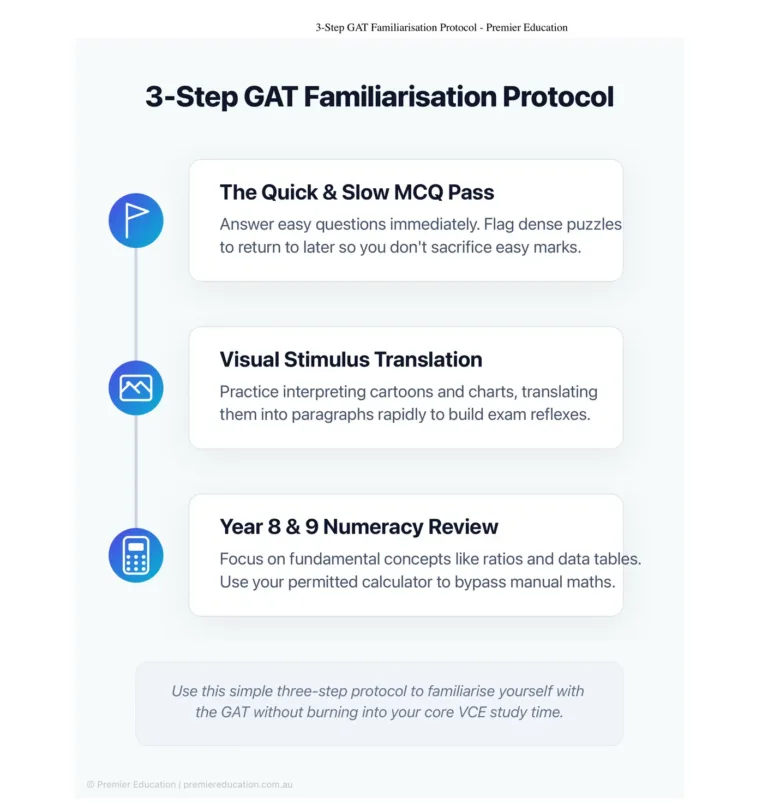
The quick and slow MCQ pass
Go through the paper once, answering everything you know immediately. Flag dense logic puzzles or complex graphs, and return to them during your second pass.
Make sure to use your allowed scientific calculator for any numeracy questions to avoid getting stuck and sacrificing easy marks.
Visual stimulus translation
For the writing components, practice quickly interpreting cartoons, infographics, or charts and translating them into structured paragraphs.
This is exactly why our VCE tutors run mock visual-analysis drills with students; it builds the reflex to extract key data rapidly without getting bogged down, a skill that translates perfectly to your final VCE English exams.
Year 8 and 9 numeracy review
Do not overcomplicate the numeracy section. The vast majority of the maths tested is grounded in fundamental Year 8 and Year 9 concepts like ratios, percentages, and reading data tables.
You will not be asked to derive calculus formulas or quote Le Chatelier’s Principle; the focus is entirely on extracting basic data from graphs and applying basic ratios. Use your permitted scientific calculator to bypass manual ratio or percentage calculations.
Understand the VCE GAT exam format and timing
Familiarise yourself with the pacing by downloading past GAT papers directly from the VCAA. A single weekend spent reviewing the format is all the preparation you need to walk into the exam room feeling confident.
VCE GAT FAQs: What students need to know
1. Can I get an exemption from sitting the VCE GAT?
Yes, but only under strict criteria such as severe illness, personal trauma, or serious intervening events. You cannot skip the GAT simply because you want more time to study for other subjects.
Any exemption request must be substantiated with an Application for authorised absence form and independent professional evidence submitted by your school to the VCAA.
2. What happens if I fail the GAT?
The GAT is not a pass-or-fail exam. Your statement of results simply indicates whether you have met the Victorian Literacy and Numeracy Standards.
A lower score does not prevent you from receiving your VCE, but it does mean your safety net (DES) might be weaker if you fall ill during final exams.
3. Do I need to bring a calculator to the GAT?
Yes, students are permitted and actively encouraged to use an approved scientific calculator for both Section A and Section B. Many numeracy questions rely on interpreting data, calculating percentages, and solving basic ratios, making a calculator essential for managing your time effectively.
4. Does the GAT test the Year 12 subject content?
No, the GAT does not test specific Year 12 subject syllabuses. Instead, it assesses your general knowledge, critical reasoning, and foundational literacy and numeracy skills developed throughout your schooling. You will not be asked to recite specific historical dates or advanced calculus formulas.
5. How can Premier Education help with VCE final exams preparation and VCE tutoring?
Premier Education supports students preparing for VCE final exams alongside personalised VCE tutoring in Melbourne. Whether you need VCE Maths tutoring, support from a VCE Chemistry tutor, or help from a VCE Physics tutor, our team focuses on building strong foundations and exam confidence.
Through structured practice, exam strategies, and tailored support, students may strengthen their reasoning skills for the GAT while improving performance across key VCE subjects.
Get GAT-ready with targeted VCE tutoring
Don’t leave your VCE results up to chance. Whether you need help deconstructing VCE Chemistry or mastering complex VCE Maths Methods concepts, our expert VCE tutors can help. Book a free assessment and consultation today to build a strategy that maximises your final ATAR.
Author
Premier Education
Our team of tutors have achieved perfect 99.95 ATARs, perfect 50 study scores, and have accumulated over 20 years of combined tutoring experience. We have made it our personal mission to not only help you succeed in Mathematics and English, but become well rounded students equipped to face any challenge in life.