
May 13, 2026
What is the VCE, and how is the ATAR calculated? The ultimate guide for parents

The VCE (Victorian Certificate of Education) is the academic passport your child earns upon graduating from high school. Meanwhile, the ATAR (Australian Tertiary Admission Rank) is the numerical rank universities use to fairly allocate course offers.
In this guide, we explain everything you need to know about the VCE and ATAR system. This includes how the VCE works, the roles of VCAA and VTAC, and how the ATAR is calculated. We also explore how to choose the right subjects based on university pathways and long-term goals.
For many families, understanding and navigating this system may feel overwhelming, which is why working with a VCE tutor may help provide clarity and confidence early on.
If you’re interested in VCE tutoring, reach out to Premier Education. With in-person or online support available, your child may benefit from flexible, tailored support.
What does VCE stand for and how does it work?
The VCE stands for the Victorian Certificate of Education. It is the mandatory senior secondary certificate awarded to students in Victoria who successfully complete Years 11 and 12.
To earn this academic passport and officially graduate from high school, students must meet specific syllabus requirements. One VCE ‘Unit’ equals one semester of study.
When a student chooses a subject, they generally commit to it for two years. Year 11 acts as the foundation, allowing students to test the waters through Units 1 and 2. Year 12 is where the stakes change, as Units 3 and 4 must be studied as a continuous, full-year sequence to generate a final study score.
VCE requirements made simple
To successfully earn the VCE according to official VCAA guidelines, your child must complete:
- A minimum of 16 units across Years 11 and 12
- At least three units from the mandatory English group
- A complete Unit 3 and 4 sequence in an approved English subject
While students have incredible freedom to choose from dozens of subjects ranging from sciences to the arts, the English requirement remains strictly non-negotiable.
Your child must complete their sequence from either VCE English (Mainstream), VCE English Language, VCE Literature, or VCE English as an Additional Language (EAL).
VCAA vs. VTAC: Who does what?
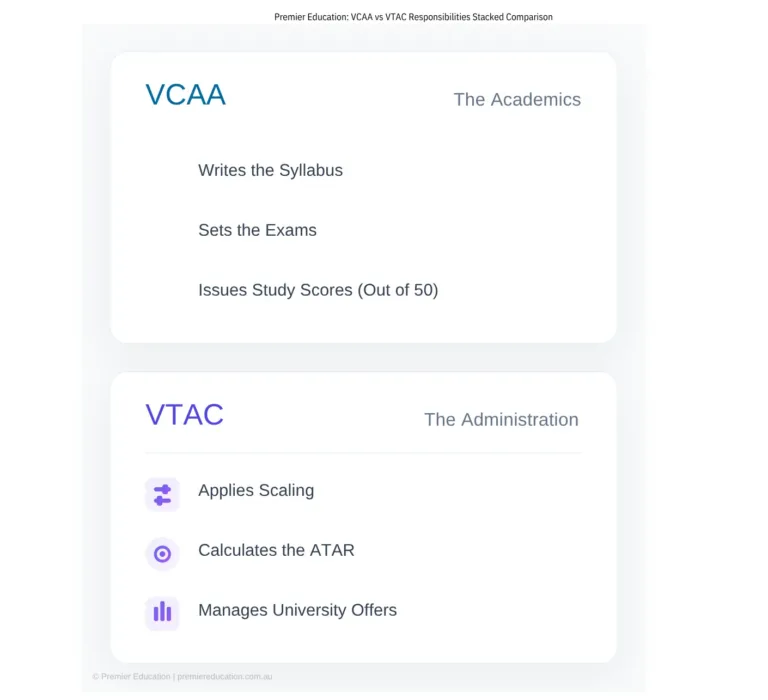
The Victorian Curriculum and Assessment Authority (VCAA) acts like the school principal. They are responsible for setting the academic syllabus, creating the rules for the Victorian Certificate of Education (VCE), and administering the final exams that your child will sit.
In contrast, the Victorian Tertiary Admissions Centre (VTAC) acts as the university gateway. Once the VCAA, as the academic architects mark the exams and issue a raw study score, VTAC takes those numbers to calculate your child’s final ATAR. VTAC also manages the actual application process for tertiary institutions.
The VCAA handles the high school academics. From there, VTAC steps in as the administrative bouncer at the university door. They do not teach, and they do not test. Their sole purpose is to adjust study scores for fairness and calculate the final rank required for tertiary applications.
What is the ATAR? (Hint: it’s not a test score)
The Australian Tertiary Admission Rank (ATAR) is a number between 0.00 and 99.95 that universities use to select students for their courses. The ATAR is strictly a percentile rank, not a percentage test score out of 100.
Think of the ATAR like a finishing placement in a marathon. If your child receives an ATAR of 75.00, it does not mean they scored 75% on their exams. It means they crossed the academic finish line ahead of 75% of all Year 12 students in their age group.
Everyone who receives an ATAR has successfully passed the VCE. The ATAR simply organises these graduates into a percentile line to help universities manage course applications fairly. The highest possible rank is 99.95, while ranks below 30.00 are reported as ‘less than 30’.
Ultimately, it is just a tool for university entry.
Keeping the ATAR in perspective
Understanding this distinction is vital for protecting your child’s well-being during Year 12.
Treating the ATAR like a school grade creates unnecessary panic. If a student gets 60% on a maths test, they might feel they have performed poorly. If they receive an ATAR of 60.00, it means they have outperformed exactly 60% of all Year 12-aged students in their demographic.
As the Deakin University ATAR guide and VTAC ATAR explanations consistently reinforce, this number is a purely bureaucratic metric. It measures relative performance in a specific year to help universities allocate limited seats in lecture halls.
It does not measure a student’s intelligence, their work ethic, or their future capacity for success.
How is the ATAR calculated?
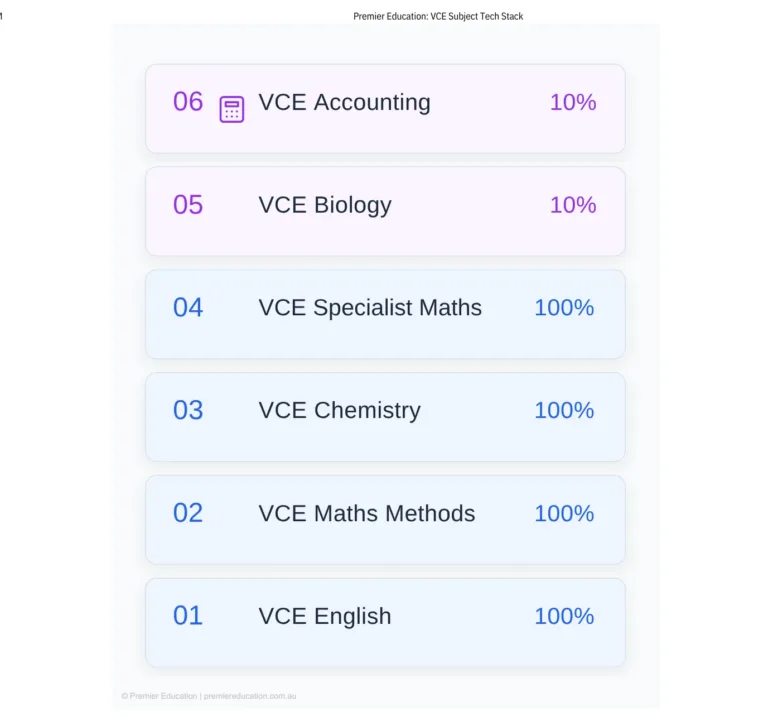
The ATAR is calculated by the Victorian Tertiary Admissions Centre (VTAC) using an aggregate of your child’s scaled study scores. This mathematical calculation is based on a maximum of six VCE subjects, combining core mandatory prerequisites with top-performing electives to generate a final percentile rank.
This aggregate is structured like this:
- The primary four: This foundational group includes your child’s highest scaled score in a mandatory English subject, plus their next three highest scaled study scores.
- The 10% increments: If your child completes additional subjects, VTAC will also add 10% of their fifth and sixth-highest subject scores to this aggregate.
Most students complete four or five subjects in Year 12, though some complete a sixth subject early in Year 11 to maximise their calculation.
Parents do not need to perform these complex calculations; VTAC handles the mathematics entirely behind the scenes. However, understanding the basic framework helps guide smart subject choices.
While there is no maximum number of subjects a student can study, only their top six will ever count toward the final ATAR.
What is VCE scaling and why does it matter?
Before any scores are added together, VTAC applies a scaling process. The VTAC scaling guide exists to level the playing field.
Because it is harder to achieve a high score against a highly competitive cohort, VTAC adjusts raw study scores up or down. This means that a 30 in one subject represents the exact same level of achievement as a 30 in any other subject.
Once all these scaled scores are added together, students are ranked in order of their total aggregate and distributed evenly across a 100-point scale.
How to choose VCE subjects for university
When choosing VCE subjects, the most important strategy is to align your child’s choices with university prerequisites. The exact ATAR your child needs and the specific subjects they must take depend entirely on the tertiary degree they want to study.
For many university degrees, students need a study score of at least 25 in VCE English (or 30 in EAL). However, highly specialised degrees require specific foundational knowledge.
We highly encourage parents and students to browse university pages together to explore specific course prerequisites before locking in their Year 11 and 12 subject selections.
Why the scaling myth often backfires
A common pitfall for families is falling for the ‘scaling myth’. Choosing a notoriously difficult subject simply because it historically scales up will often backfire if the student struggles with the content. A low raw score that scales up slightly will always result in a lower aggregate than a high raw score in a subject the student genuinely enjoys.
As our Senior VCE Academic Coaches regularly advise parents:
‘We consistently see students burn out by choosing advanced subjects purely for scaling; we always advise choosing subjects based on genuine aptitude’.
Key VCE subject requirements for competitive courses
Common prerequisites for highly competitive fields include:
| University Pathway | Mandatory Subject Prerequisites | Highly Recommended Subjects |
|---|---|---|
| Medicine | Minimum 25 in English (30 in EAL); Minimum 30 in Chemistry (Monash specific) | VCE Chemistry, VCE Biology, VCE Maths Methods |
| Engineering | Minimum 25 in English (30 in EAL); Minimum 25 in Maths Methods | VCE Physics, VCE Specialist Maths, VCE Maths Methods |
VCE subjects for medicine
Medical degrees are intensely competitive and require strong foundational knowledge in the sciences.
- Gatekeeper subject: VCE Chemistry. Without a study score of at least 30, direct entry into programs such as Monash Medicine becomes impossible.
- Core science: VCE Biology. Provides excellent context and foundational knowledge for university-level medical coursework.
- Recommended skills: VCE Maths Methods. Builds the analytical and quantitative skills required for clinical problem-solving.
VCE subjects for engineering
Engineering degrees rely heavily on applied mathematics and an understanding of the physical world.
- Gatekeeper subject: VCE Maths Methods. A standard mathematical prerequisite for nearly all engineering degrees.
- Highly recommended: VCE Physics. Universities strongly favour students who challenge themselves with foundational physical sciences.
- Recommended skills: VCE Specialist Maths. Completing this advanced subject during high school drastically reduces the need for expensive, time-consuming bridging courses during the first year of a university degree.
VCE and ATAR FAQs
1. What is VCE subject scaling?
Scaling is a mathematical adjustment applied by VTAC to ensure no student is advantaged or disadvantaged by their subject choices. It balances scores so that a 30 in a highly competitive subject represents the same level of achievement as a 30 in any other subject.
2. What is a VCE study score?
A VCE study score is a number between 0 and 50 showing how a student performed in a specific subject compared to everyone else who took that subject in Victoria. A score of 30 represents the state average. It is calculated using a combination of school-based assessments (SACs) and final external exams.
3. What subjects scale up in VCE?
Subjects that generally attract highly competitive cohorts, such as VCE Specialist Mathematics or certain Languages like French or Chinese, are typically scaled up by VTAC according to the official VTAC Scaling Guide.
This mathematical adjustment ensures fairness across the state so students aren’t disadvantaged by taking difficult subjects. However, students should never pick a subject solely for its scaling.
4. What is a good ATAR?
A ‘good’ ATAR is entirely subjective and depends exclusively on the university course your child wants to enter. While the national average sits around 70.00, a good score is simply the minimum rank required to unlock their chosen degree. It is a placement tool, not a measure of intelligence.
5. Do Year 11 subjects count towards the ATAR?
Typically, only Unit 3 and 4 sequences generate a study score that counts towards the ATAR, and these are usually taken in Year 12. However, some students choose to complete a Unit 3 and 4 subject early in Year 11. In that case, the score will count towards their final ATAR calculation.
6. What is the benefit of VCE tutoring?
VCE tutoring provides structured academic support across key subjects, helping students stay on track with coursework and exam preparation.
At Premier Education, we have high-achieving chemistry, physics, maths tutors and more to help your child improve their understanding, confidence, and overall results.
Setting your child up for success with VCE tutoring
By understanding that the VCE is simply an academic passport and the ATAR is just a marathon placement rank, parents can drastically reduce household anxiety.
The most effective strategy is to ignore the complex scaling mathematics, focus heavily on university prerequisites, and encourage your child to choose subjects that align with their strengths and future goals.
Feeling overwhelmed by university prerequisites? Download our Student Handbook to map out your child’s ideal pathway.
Want to make sure your child is on track for their dream ATAR? Book a free assessment and consultation with our expert VCE tutors today. We’ll help build a tailored academic plan that takes the stress out of Years 11 and 12.
Author
Premier Education
Our team of tutors have achieved perfect 99.95 ATARs, perfect 50 study scores, and have accumulated over 20 years of combined tutoring experience. We have made it our personal mission to not only help you succeed in Mathematics and English, but become well rounded students equipped to face any challenge in life.