
May 6, 2026
VCE SACs and VCAA statistical moderation explained

VCE School-assessed Coursework (SACs) are internal assessments designed primarily to determine a student’s achievement rank within their school cohort. End-of-year external examinations then serve as the standardising measure used to calculate the final statistically moderated score.
If you’re unsure how SACs and statistical moderation work, this guide breaks it down step by step. This includes what SACs are, how they’re assessed, why your rank matters, and how they contribute to your final study score and ATAR.
If you’re feeling confused, reach out to Premier Education. Our expert VCE tutors may help you understand your requirements, plan your studies, and work towards stronger results.
What are VCE SACs, and what does it stand for?
SAC stands for School-Assessed Coursework. These are mandatory internal assessments conducted by your school during the VCE to measure your understanding of specific Area of Study outcomes.
While Unit 1 and 2 SACs determine basic progression, Unit 3 and 4 SACs actively contribute to your final study score and ATAR.
The SAC format of varies entirely depending on the subject’s VCAA Study Design; it might be a written essay, a laboratory report, a short-answer test, or an oral presentation.
Because every school writes and marks its own SACs differently, raw scores are not an accurate reflection of your final grade. Instead, SACs are primarily used to establish your achievement rank amongst your school cohort before statistical moderation is applied.
Unit 1 and 2 vs Unit 3 and 4: What changes?
Moving from Year 11 into Year 12 requires a fundamental shift in how you view classroom assessments. Teachers use Units 1 and 2 SACs as developmental milestones to verify that you have grasped the foundational concepts required to progress. They will award one of two outcomes:
- Satisfactory (S): You have demonstrated sufficient understanding of the required outcomes
- Not Satisfactory (N): You have not yet met the required standard for the unit outcomes
The numerical grade matters very little to the Victorian Curriculum and Assessment Authority (VCAA) at this stage. However, once you commence Units 3 and 4, these internal assessments carry substantial weight. They demand a deeper level of analytical thinking and consistent performance throughout the year.
The exact nature of the assessment will look drastically different depending on your chosen timetable. A VCE chemistry student might be assessed via a rigorous practical investigation, whereas a literature student will submit an extended comparative essay.
How much do SACs contribute to your ATAR and study score?
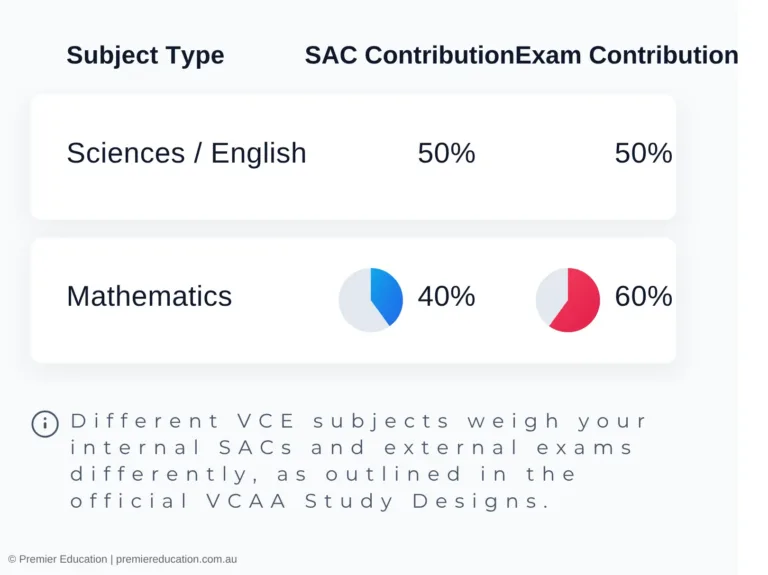
The exact contribution of your School-Assessed Coursework depends entirely on the VCAA Study Design for each specific subject. SACs generally range from 40 to 50 per cent of your overall study score, with the final external examination contributing the remaining balance.
How VCE exam weightings work in practice
For example, in VCE Biology, VCE Chemistry, and VCE English, your Unit 3 and 4 SACs combined make up exactly 50 per cent of your final mark, with the end-of-year examination contributing the remaining 50 per cent.
Conversely, in mathematical subjects like VCE General Mathematics and VCE Mathematical Methods, your internal SACs account for 40 per cent of your study score, placing a heavier 60 per cent weighting on your external examinations.
It is crucial to familiarise yourself with the VCAA website to understand your subject’s exact breakdown. Regardless of the specific weighting, your SACs establish your internal rank, which is then mapped to the external exam.
Planning your study around SAC and exam weightings
To plan your study schedule effectively, you need to understand exactly where your marks come from. Below is a breakdown of how the VCAA allocates assessment weighting for several highly popular subjects:
| VCE Subject | Unit 3 SAC Weighting | Unit 4 SAC Weighting | External Exam Weighting | Official Study Design |
|---|---|---|---|---|
| Biology | 20% | 30% | 50% | VCAA Biology |
| Chemistry | 20% | 30% | 50% | VCAA Chemistry |
| English | 25% | 25% | 50% | VCAA English |
| General Mathematics | 24% | 16% | 60% (Two exams at 30% each) | VCAA General Maths |
| Mathematical Methods | 20% | 20% | 60% (Exam 1: 20%, Exam 2: 40%) | VCAA Maths Methods |
Recognising this composition allows you to prioritise your efforts.
A 50 per cent exam weighting in English demands sustained essay practice. In comparison, the 60 per cent exam weighting in mathematics subjects indicates that mastering the final external assessment is even more critical to your overall success.
Why does your SAC rank matter more than your raw score?
Because SACs are written and graded internally, difficulty varies drastically between schools. This makes a raw score meaningless on its own. VCAA statistical moderation fixes this disparity by using your absolute mark solely to determine your exact ranking relative to every other student in your specific school cohort.
If your teacher is a harsh marker and the class average is 50 per cent, your 70 per cent places you ahead of the curve. However, if the SAC was incredibly easy and the class average is 85 per cent, that same 70 per cent is worth substantially less.
Your final SAC mark is heavily modulated by how well your overall school cohort performs on the standardised external end-of-year examination.
Why raw SAC scores can be misleading
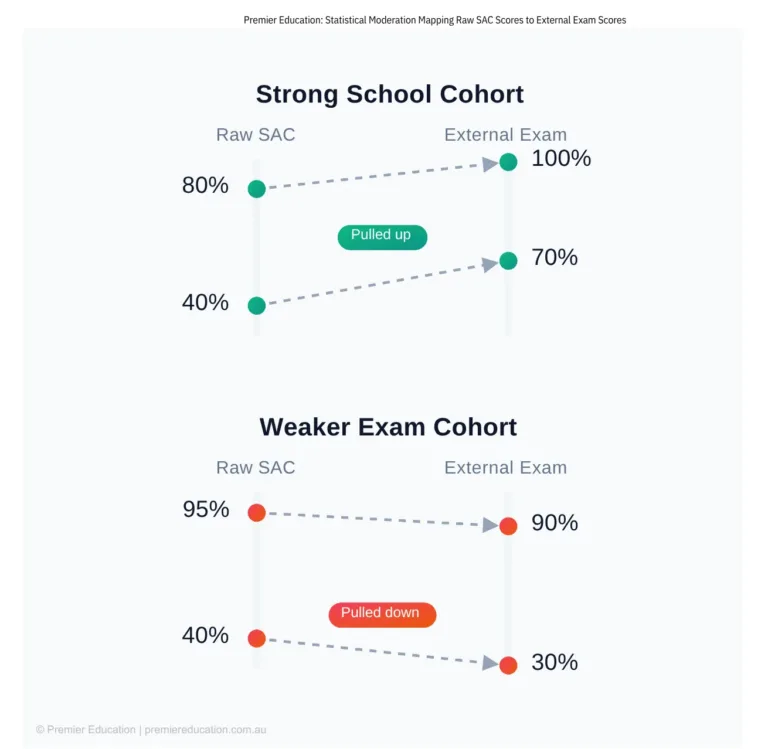
Raw SAC marks cannot be accurately compared between different schools, as they are localised measurement tools. To understand why this happens, consider how two different schools might assess the exact same Area of Study:
- School A (Highly Complex Assessment): The teacher designs a rigorous paper to challenge their most capable students. As a result, the highest-achieving student scores an 80 per cent, and the lowest scores a 40 per cent.
- School B (Foundational Assessment): The teacher designs an easier, foundational paper. The top student achieves a 95 per cent, and the lowest achieves an 80 per cent.
If the VCAA took these raw marks at face value, students at School A would be severely and unfairly disadvantaged simply because their teacher set a more rigorous assessment.
Statistical moderation acts as a mathematical bridge, ensuring fairness. It evaluates the raw scores, ranks them, and waits for the external exam to reveal the true academic strength of each cohort.
Step-by-step: How VCAA statistical moderation calculates your score
The VCAA statistical moderation process mathematically aligns your school’s internal assessment scale with the standard statewide external exam scale.
This critical calculation adjusts internal marks to reflect true statewide academic performance, ensuring fairness across all schools while strictly maintaining the original rank order determined by your teachers.
To achieve this, the VCAA follows three distinct steps:
- Identify the moderation group: First, VCAA identifies your moderation group, which includes all students enrolled in a specific study at your school.
- Form the external score: Second, an external score is formed using everyone’s end-of-year examination results, creating a common measurement scale across the entire state.
- Align the scales: Finally, VCAA aligns the internal school-based assessment scale with this external exam scale. They take the highest moderated score and align it with the highest external score. They then map the median and quartiles of the internal scores to the median and quartiles of the external scores.
Importantly, anomalies are removed entirely from the alignment process.
What most students get wrong about SAC statistical moderation
The mechanics of this system are often misunderstood, leading to damaging playground myths.
The most persistent myth is that one student failing the final exam will drastically drag down the scaled SAC scores of the entire class. The VCAA Statistical Moderation guide explicitly debunks this.
If a student performs significantly worse on the exam than their coursework predicted, their result is omitted from the alignment calculations, so peers are not penalised. The same rule applies to students who receive a Derived Examination Score.
Furthermore, the VCAA does not alter the internal rank order established by your classroom teacher. If you achieve the highest SAC scores in your moderation group internally, you are mathematically guaranteed to receive the highest statistically moderated SAC score for your group, regardless of how the numbers shift.
What happens if you fail a SAC in Year 12?
Failing a single SAC does not mean you will automatically fail your VCE. If you receive an unsatisfactory score, most schools have a specific process that allows you to complete a redemption task to demonstrate competency and stay on track to graduate.
While the VCAA mandates the opportunity to achieve a satisfactory result, the exact format of a redemption task is entirely at the individual school’s discretion. Passing this secondary task will allow your teacher to award you an ‘S’ (Satisfactory) for that specific unit outcome, as outlined in the VCAA administrative guidelines for Satisfactory Completion.
However, while the redemption task allows you to pass the unit, your original failing percentage will typically remain on your record for calculating your final study score and ATAR.
Why one SAC won’t define your ATAR
Because VCE is a cumulative endurance metric, a single poor result can often be mitigated by performing exceptionally well on your final examinations. Dwelling on a past assessment you cannot change is counterproductive to your overall VCE strategy.
The most successful students use an underperforming SAC as diagnostic data. It highlights exact knowledge gaps and weaknesses in exam technique that require immediate attention.
By treating a poor SAC purely as diagnostic data, you can isolate exact knowledge gaps and immediately adjust your exam strategy to secure your future study score rather than repeating the mistakes of the past.
Why your VCE final exam is the ultimate equaliser
While you spend an entire year systematically preparing for multiple SACs, your final exam dictates 50 to 60 per cent of your overall mark in a mere two to three hours. This means your performance in that short window carries the exact same weight as a year of internal coursework.
Furthermore, your personal exam score does not directly overwrite your individual SAC mark. This is because moderation is applied to the cohort pool rather than to the individual. Scoring highly on the exam is the only way to independently drive your final study score upward, regardless of your school’s SAC difficulty.
You cannot change past SAC results, but preparing methodically for this final assessment is the highest-leverage activity a VCE student can undertake. The best results come from those who finish learning the curriculum early and dedicate months solely to exam simulation.
How to prepare for your VCE exams effectively
Many students mistakenly view their final exams merely as the last hurdle of the year. In reality, the exam is the central pillar of your entire VCE result. Your exam score does not merely sit alongside your SAC scores; it directly determines their ultimate value through the statistical moderation process.
Because of this profound leverage, pacing your academic year is critical. VCE is an endurance race.
At Premier Education, our instructional methodology is built entirely around this reality. By accelerating through the coursework syllabus with a dedicated VCE tutor, our students complete their initial learning phase ahead of their peers.
This strategy carves out two to three clear months at the end of the year exclusively for dedicated, rigorous exam preparation.
Answering questions about VCE SACs and statistical moderation
1. What does VCE SAC stand for?
SAC stands for School-Assessed Coursework. These are mandatory internal assessments written and graded by your school teachers throughout VCE Units 3 and 4. They are designed to evaluate your understanding of specific syllabus outcomes before the final external examinations.
2. Do VCAA statistical moderation rules change a student’s rank?
No, VCAA statistical moderation never changes the rank order of students determined by the school’s internal SAC marks. If you are ranked first in your school cohort for your internal SACs, you will maintain that first-place rank after all statistical moderation is applied.
3. Does one student failing an exam bring down the class SAC scores?
No, VCAA removes anomalously low external performances from the data pool entirely. This ensures that a student who unexpectedly performs poorly on the final exam will not drag down their peers’ statistically moderated SAC scores during the alignment process.
4. How much do SACs contribute to the ATAR?
Depending on the specific subject’s study design, SACs generally contribute between 40 per cent and 50 per cent to your final subject study score. For example:
- 50% SAC / 50% Exam split: Subjects like Biology, Chemistry, and English
- 40% SAC / 60% Exam split: Mathematically intensive subjects like General Mathematics and Mathematical Methods
This study score is then mathematically scaled and combined with your other subjects to calculate your overall ATAR.
5. How can Premier Education help with my VCE preparation?
At Premier Education, our experienced VCE tutors may support you with structured, results-focused learning across a range of subjects. Whether you need VCE maths tutoring, VCE chemistry tutoring, VCE physics tutoring, or support with another subject, our team has the expertise to guide you.
Our approach is designed to help you build confidence, improve consistency, and prepare effectively for both SACs and final exams.
Choose VCE tutoring to prepare smarter and finish strong
Taking control of your VCE outcome requires looking beyond the raw percentage on your classroom test. Success comes from understanding that internal assessments secure your cohort rank, while comprehensive exam preparation unlocks your final scaled score.
Ensure you have a clear view of your academic pathway by downloading our free Student Handbook to map out your subjects today. VCE is an endurance race, and the students who win are the ones who prepare methodically for the final stretch.
At Premier Education, we finish the curriculum early, so you get two to three months of dedicated exam preparation, giving you the ultimate advantage when it matters most.
Our VCE tutors have achieved perfect 99.95 ATARs and perfect study scores, so you can trust they have the experience you need. Book a free consultation, assessment and trial today to secure your future ATAR.
Author
Premier Education
Our team of tutors have achieved perfect 99.95 ATARs, perfect 50 study scores, and have accumulated over 20 years of combined tutoring experience. We have made it our personal mission to not only help you succeed in Mathematics and English, but become well rounded students equipped to face any challenge in life.